


Candidate Reactions to AI Interviews: What the Research Says

Candidate reactions to AI interviews are more nuanced than the headline assumption suggests. The research doesn’t show universal rejection — it shows that candidates dislike specific, fixable things about how AI interviews are implemented: opaque processes, surprise deployment without warning, sessions that feel like endurance tests, and silence afterward. Transparent, well-designed AI interview experiences produce acceptance rates that rival traditional phone screens.
Understanding what drives negative reactions — and what measurably improves acceptance — is the difference between a screening process that damages your employer brand and one that candidates respect. This post pulls together the research, identifies which candidate segments react most negatively, and gives you the specific design changes that move acceptance rates. For full context on how AI interview design fits into your wider screening pipeline, see The Complete Guide to AI-Powered Interviews.
Key Takeaways
61% of candidates say they’re comfortable with AI-led first-round screening when the process is transparent (LinkedIn Talent Solutions, 2024). The qualifier matters: transparency is the operative condition.
The strongest predictor of negative candidate reaction isn’t the AI itself — it’s the absence of explanation about how scores are used and who reviews them.
Senior candidates and passive job seekers react more negatively than active entry-level applicants. The format should match candidate expectations for the role level.
Completion rates improve 15–20 percentage points when invitation emails explain the process clearly, include a practice question, and specify the session length upfront.
Employer brand impact is real. Candidates who report a poor AI interview experience are 2.4x more likely to share that experience publicly than those who report a positive one (IBM Institute for Business Value, 2024).
What the Research Actually Shows
Candidate acceptance of AI interviews is higher than most hiring teams expect — but it’s strongly conditional on process transparency, session length, and whether a human follows up promptly after completion.
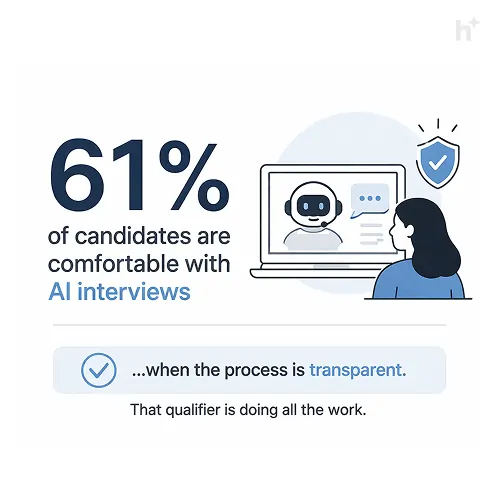
LinkedIn’s 2024 Global Recruiting Trends data shows that 61% of candidates are comfortable with AI-led first-round screening. That’s a majority. But the same research shows acceptance drops sharply when candidates don’t understand what the AI is evaluating, how scores are used, or who reviews the output.
IBM Institute for Business Value research found that candidates are broadly willing to engage with AI in hiring when they perceive the process as fair and explainable. The perception of fairness — not the actual fairness — is the critical variable. A well-designed AI process that candidates understand feels fairer than a poorly communicated one, regardless of the underlying quality.
The nuance the headline numbers miss: acceptance varies significantly by candidate segment, role level, and how the AI interview was introduced. Aggregated acceptance figures obscure the cases where AI interviews cause real damage to candidate experience and employer brand.
Who Reacts Most Negatively — and Why
Senior candidates, passive job seekers, and candidates in fields where personal relationships are central to professional identity react most negatively. The common thread is that AI interviews feel misaligned with the level of investment the role warrants. For a direct comparison of how AI and human interviewers perform across different role types and seniority levels, see AI vs Human Interviewers: Key Differences.
Senior and leadership candidates. A VP-level candidate receiving an async AI interview as their first contact with a company often interprets it as a signal about how the company values the position — or them. The format implies a transactional process that doesn’t match the gravity of a leadership hire.
Passive candidates. Someone who isn’t actively looking and was approached through outreach has a higher tolerance threshold for process friction. If the first meaningful interaction is an automated video screen, many will disengage rather than comply.
Candidates in relationship-centric fields. Professional services, sales, therapy, consulting. Roles where interpersonal skills are the core value proposition. Candidates in these fields often see AI screening as a contradictory signal — “you’re hiring me for human judgment, and your first evaluation of me is algorithmic.”
Candidates with lower digital confidence. Less common in professional hiring contexts but present in volume hiring scenarios. Unfamiliarity with the technology format drives abandonment unrelated to role fit. A practice question and clear instructions significantly reduce this drop-off.
What Specifically Drives Negative Reactions
The research consistently identifies four drivers of negative candidate reaction: lack of process transparency, session length, absence of human follow-up, and uncertainty about how AI scores influence the decision.
No explanation of the process. Candidates who receive an AI interview invitation without a clear explanation of what will happen, how long it takes, and who reviews the output report significantly lower satisfaction scores. The AI isn’t the problem — the opacity is.
Sessions that feel too long. Completion rate data shows sharp drop-off above 25 minutes. Candidates who do complete longer sessions often report feeling like the process didn’t respect their time. The sweet spot from candidate experience research is 15–20 minutes for entry and mid-level roles.
No human contact after completion. Candidates who complete an AI interview and hear nothing for more than 5 days report lower employer brand scores than those who receive a human touchpoint within 48 hours. The AI does the evaluation; a human still needs to close the communication loop.
Uncertainty about AI decision-making. “Does the AI decide if I get the job?” is the most common concern candidates report. When the answer is clearly communicated — the AI produces a ranked shortlist that a human recruiter reviews — anxiety decreases measurably. When it’s left ambiguous, candidates assume the worst.
⚠️ Watch Out: Candidates who feel the AI interview process was unfair or opaque are significantly more likely to share that experience publicly. At high volume, even a small percentage of negative sharers can produce visible employer brand damage. The invitation email and post-completion communication are your primary brand protection tools.
What Improves Candidate Acceptance
Five specific changes consistently improve acceptance rates: transparent process explanation, session length under 20 minutes, a practice question before the real assessment, prompt human follow-up, and explicit communication about how AI scores are used. For a deeper operational breakdown of how to implement these across high-volume roles, see AI Interview Best Practices for High-Volume Hiring.
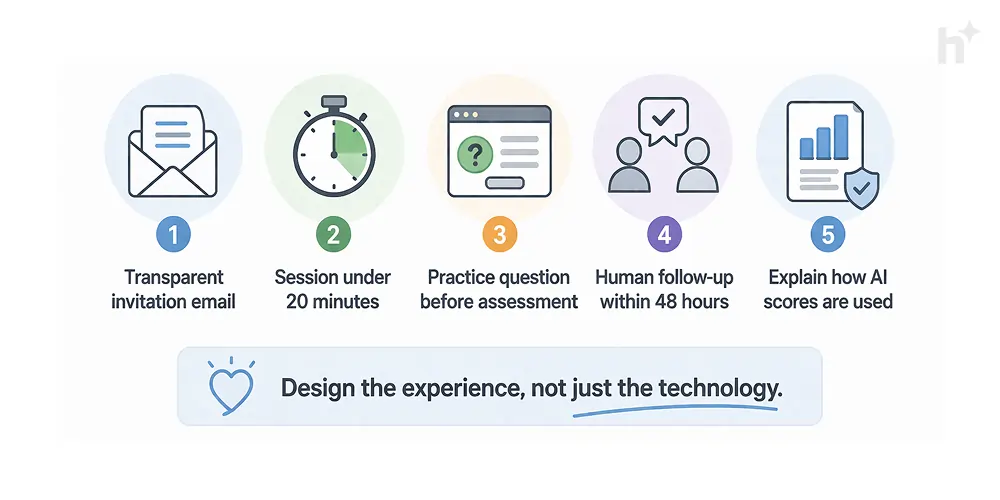
Transparent invitation copy. An invitation email that names the AI, explains the format, specifies duration, and describes how scores feed into the decision produces meaningfully higher completion rates than a generic link. The difference in completion rate between transparent and opaque invitation emails ranges from 12–22 percentage points across multiple studies (HireVue Candidate Experience Research, 2024).
Session under 20 minutes. Every minute above 20 increases abandonment and reduces post-session satisfaction scores. Six well-chosen questions in 18 minutes outperforms ten questions in 35 minutes on both completion rate and candidate experience.
Practice question. Offering a non-scored practice question before the real assessment reduces anxiety-driven abandonment and improves response quality. Candidates who use the practice question score more consistently across the real questions, suggesting reduced performance anxiety.
Human follow-up within 48 hours. A brief email from a recruiter acknowledging receipt and setting expectations for next steps — even if it’s automated-personalised rather than truly manual — significantly improves candidate experience scores post-AI interview.
Explicit AI transparency statement. A single sentence in the invitation explaining that the AI produces a ranked shortlist reviewed by a human recruiter — and that no automatic rejections are made without human review — reduces the most common candidate concern about algorithmic decision-making.
💡 Pro Tip: Draft your AI interview invitation email as if you’re explaining the process to a candidate you respect and want to hire. Read it back. If it sounds defensive or vague about how scores are used, rewrite it. The best invitation emails feel like a helpful briefing, not a legal disclosure.
The Employer Brand Risk
Candidates who report a poor AI interview experience are 2.4× more likely to share it publicly than those reporting a positive experience (IBM Institute for Business Value, 2024). At high volume, the tail risk of negative employer brand impact from poorly designed AI screening is material.
Glassdoor, LinkedIn, and niche industry forums regularly feature candidate accounts of AI interview experiences. The accounts that go viral are almost always about opacity or disrespect — long sessions with no explanation, no human follow-up, automatic rejection emails sent before the candidate finished reviewing their own response.
None of those are technology failures. They’re process design failures. The AI interview platform didn’t create those experiences — the configuration decisions did.
SHRM’s candidate experience benchmarking research consistently identifies the post-interview communication gap as the single most cited source of negative candidate feedback in structured hiring programmes. The response window matters more than most hiring teams account for.
For high-volume hiring programmes specifically, the math matters. A campaign that processes 500 candidates and produces a 10% dissatisfaction rate from opaque process design generates 50 potential negative sharers. Even if 5% of them post publicly, that’s visible brand damage from a preventable source.
The fix is design-level, not technology-level. Transparent processes, appropriate session lengths, and timely follow-up move the dissatisfaction rate to under 5% in most implementations.
Real-World Use Cases
The cases where AI interview candidate experience improvements produce measurable business outcomes are almost always cases where the invitation email and post-completion communication were redesigned alongside the screening technology.
SaaS Scale-Up — Rewriting the Invitation. A 250-person SaaS company had a 58% AI interview completion rate and a steady stream of negative Glassdoor mentions referencing their interview process as “robotic.” They redesigned the invitation email to explain the AI platform by name, describe the session format, specify the 18-minute duration, confirm a practice question was available, and state that a human recruiter reviewed all shortlists. Completion rate rose to 77% within two hiring cycles. Glassdoor mentions of the interview process shifted from predominantly negative to predominantly neutral or positive.
Retail — High-Volume Seasonal Hiring. A national retailer running AI interviews for 600 seasonal associates received internal complaints from store managers about candidate quality. Investigation revealed that the AI interview session was 34 minutes — too long for entry-level candidates applying on mobile devices. They shortened to 18 minutes and 5 questions. Completion rate improved from 49% to 71%. Candidate quality perception among store managers improved, because the shorter session was completed by candidates who genuinely wanted the role rather than those who pushed through out of obligation.
🏆 Best Result: The SaaS invitation redesign: completion rate +19 points, Glassdoor sentiment shift from negative to neutral/positive. No technology change. Purely a communication design improvement.
Metrics to Track
Candidate experience metrics for AI interviews split into two categories: completion behaviour (measurable in real time) and sentiment (measurable through post-process surveys and employer review sites).
| Metric | What It Measures | Target |
|---|---|---|
| Completion Rate | Process acceptance and UX quality | 70%+ (below 60% = immediate review) |
| Drop-off Point | Where candidates abandon | Flag any question losing 15%+ |
| Post-Interview Survey Score | Candidate satisfaction with process | 4.0+ out of 5.0 |
| Glassdoor / LinkedIn Mentions | Public employer brand signal | Monitor monthly; negative spikes need root cause analysis |
| Time-to-Human-Follow-Up | Recruiter responsiveness post-AI | < 48 hours for shortlisted candidates |
Frequently Asked Questions
Do candidates prefer AI or human interviews at first-round stage?
For entry-level and mid-level roles, the preference is roughly split when the AI process is transparent and well-designed. Active job seekers often appreciate the flexibility of async completion. The preference shifts toward human contact for senior roles, passive candidates, and relationship-centric positions regardless of design quality.
Does using AI interviews hurt employer brand?
Poorly designed AI interview programmes can. Transparent, well-communicated programmes typically don’t — and in some cases improve employer brand by signalling that the company respects candidate time with a structured, efficient process. The design and communication quality is the variable, not the technology itself.
How do I measure candidate reaction to our AI interview process?
Three ways: completion rates (tracked by platform), post-interview pulse surveys (sent automatically after completion), and periodic Glassdoor/LinkedIn monitoring. Completion rate is the leading indicator — it tells you immediately whether something is wrong with the process design. Survey scores tell you why.
Are there demographic differences in AI interview acceptance?
Yes. Research shows younger candidates (Gen Z and early Millennials) report higher comfort with AI-led interviews than older cohorts. Candidates in tech-adjacent fields report higher comfort than those in relationship-centric professions. These differences are consistent but not determinative — process design quality affects all groups’ acceptance rates.
Should I tell candidates they’re being interviewed by AI?
Yes, and in some jurisdictions you’re legally required to. Beyond compliance, transparency is the single highest-leverage improvement available to most AI interview programmes. Candidates who know what to expect complete at higher rates, perform with less anxiety, and report better experience scores regardless of their prior attitude toward AI.
Conclusion
The research on candidate reactions to AI interviews doesn’t support a simple verdict in either direction. Candidates aren’t uniformly negative about AI screening — they’re negative about specific design failures that are entirely fixable: opacity, excessive length, no human follow-up, and ambiguous communication about how AI scores influence decisions.
Teams that treat AI interview design with the same care as their job descriptions and offer letters find that candidate acceptance is achievable, completion rates are high, and employer brand impact is neutral to positive.
For teams ready to embed this approach into a broader hiring system, Building an AI-First Recruitment Strategy covers how candidate-centric AI interview design fits into a full-funnel recruitment framework — from job criteria configuration through to offer.
Ready to hire smarter?
Turn hiring insights into faster shortlists with hiremore AI.
Build structured pipelines, screen candidates with AI, and keep your team aligned from first application to final offer.