
An AI-powered ATS that simplifies shortlisting, tagging, and workflows - built for fast, scalable, and collaborative hiring.
Landing Pages
Copyright © 2026|hiremore AI
An AI-powered ATS that simplifies shortlisting, tagging, and workflows - built for fast, scalable, and collaborative hiring.





Most companies are still running interviews the same way they did in 2005. One recruiter, one calendar, one set of notes — repeated hundreds of times for a single role. It’s slow, expensive, and inconsistent in ways that create real legal and quality risk. AI powered interviews change that equation.
An AI-powered interview is a structured, software-led assessment where candidates respond to predefined questions on video or voice, and an AI engine scores their answers against calibrated role criteria — without a human interviewer present. Companies using hiremore AI have cut time-to-screen from 5 days to under 18 hours for roles with 150+ applicants.
This guide is for hiring leaders, HR professionals, and recruitment ops teams who want to understand how AI interviews work, where they deliver value, and what to watch out for before going live.
AI powered interviews evaluate every candidate against the same criteria, eliminating the interviewer inconsistency that affects 67% of unstructured hiring processes (LinkedIn, 2024).
Companies switching to AI-led first-round screening reduce time-to-screen from 4–6 days to under 24 hours.
AI scoring works best when configured against role-specific competencies — not generic keywords. Misconfiguration is the leading cause of poor results.
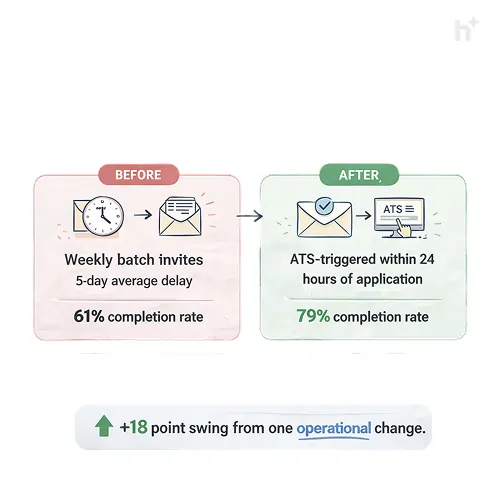
Candidate completion rates average 74% when invitations are sent within 48 hours of application.
AI interviews don’t replace human judgment. They filter at scale so your best interviewers spend time on candidates who actually matter.
AI powered interviews are structured, software-led assessments where candidates respond to predefined questions, and an AI engine scores their answers against calibrated job criteria — no human interviewer required.
Traditional phone screens are gate-keeping tasks. They’re time-consuming and inconsistent — different interviewers ask different questions, weigh answers differently, take notes in different ways. Research from Harvard Business Review attributes much of this to decision fatigue: the same candidate gets wildly different outcomes depending on who’s on the call and how many screens that interviewer has already done that day.
AI interviews solve the consistency problem by standardising both the question set and the scoring logic. The AI doesn’t get tired on candidate 47. It doesn’t warm to someone who went to the same university. It applies the rubric and produces a score.
The technology combines natural language processing (NLP) to analyse verbal content, speech analysis to assess delivery patterns, and structured scoring models to rank candidates against defined role competencies. For a detailed breakdown of exactly how that scoring works under the hood, see AI Interview Scoring: How Candidates Are Evaluated. hiremore AI’s engine processes video responses in real time, generating competency scores within minutes of submission.
First-round interviews are the biggest scheduling bottleneck in most pipelines. AI removes that bottleneck entirely — candidates self-schedule, complete async, and return a ranked shortlist the same day.
A recruiter at a 500-person company hiring for 20 roles simultaneously can spend 35–40% of their working week just on first-round phone screens. McKinsey’s research on automation in HR functions identifies first-round screening as one of the most automatable activities in the recruiting workflow — high-volume, repetitive, and rules-based. That’s not a hiring function — it’s a scheduling function.
Speed. Candidates complete interviews within 24–48 hours of invitation. One hiremore AI customer in logistics reduced time-to-shortlist from 8 days to 22 hours for a 300-applicant role.
Consistency. Every candidate answers the same questions, scored against the same rubric. You’re comparing apples to apples — and your screening process is documented and auditable.
Scale. A recruiter can realistically cover 12–15 phone screens a day. An AI interview platform handles 500 in the same window with no quality drop.
The honest limitation: AI interviews work best for roles where competency criteria are well-defined. For senior leadership or highly relationship-driven roles, they’re better as a supplementary layer than a primary screen — AI vs Human Interviewers: Key Differences lays out exactly which roles and stages suit each approach.
The four primary benefits are time savings on first-round screening, consistent evaluation, scalability during surges, and a documented record that supports compliance audits.
Processing speed. Hiring surges that would back up a recruiter’s calendar for two weeks get processed overnight.
Structured consistency. Every candidate in identical conditions. The 6-second resume glance problem doesn’t apply — the AI evaluates the full response.
24/7 candidate availability. Candidates complete on their own schedule — evenings, weekends, any timezone. Completion rates improve and you stop losing good people to scheduling friction.
Documented audit trail. Every interview is recorded, scored, and logged. When a hiring decision is questioned, you have a structured record. Unstructured phone screens leave no such trail.
| Dimension | Traditional Screen | AI-Powered Interview |
|---|---|---|
| Time per candidate | 20–40 minutes | Async, self-scheduled |
| Candidates per day | 12–15 | 200–500+ |
| Consistency | Low (varies by interviewer) | High (fixed rubric) |
| Scheduling friction | High | None |
| Audit trail | None or partial notes | Full recording + score log |
| Timezone coverage | Business hours only | 24/7 |
📊 Key Stat: Companies using structured AI interview platforms report a 40–60% reduction in time-to-hire for high-volume roles. (LinkedIn Talent Solutions, 2024 Global Recruiting Trends)
AI powered interviews run in five stages — criteria setup, candidate invitation, async session, automated scoring, and recruiter review — each producing a structured output that feeds the next.
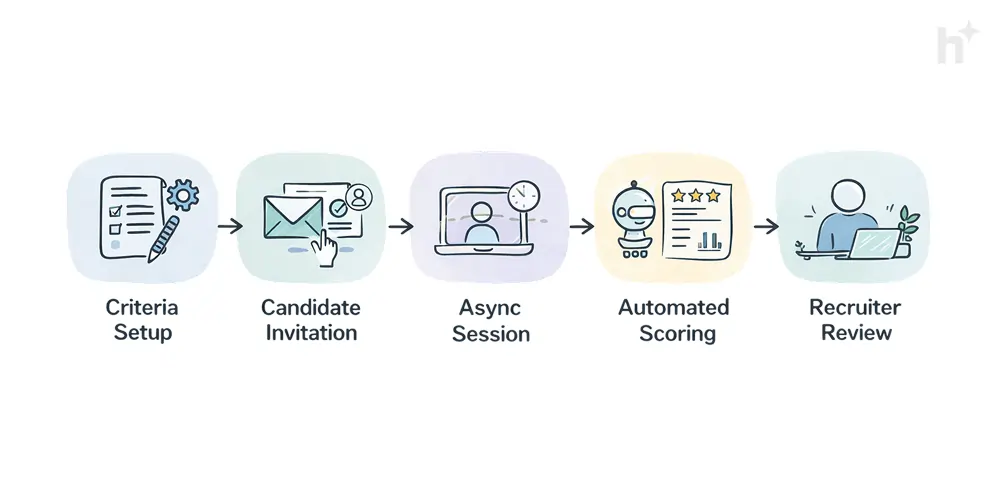
💡 Pro Tip: The quality of your criteria setup determines 80% of your results. Vague criteria produce noisy scores. Specific, observable competency definitions produce useful rankings.
| Stage | Recruiter Time | Candidate Action |
|---|---|---|
| Criteria Setup | 1–2 hrs (one-time per role) | None |
| Invitation | 15 min | Opens invite |
| Interview Session | None | Completes 15–25 min async |
| Automated Scoring | None | None |
| Recruiter Review | 30–45 min per 50 candidates | None |
The single highest-impact practice is configuring your scoring rubric against specific, observable competencies before sending a single invitation.
Define competencies at the behaviour level. ‘Strong communicator’ means nothing to a scoring engine. ‘Structures a complex answer with clear context, action, and measurable result’ is scoreable.
Keep interview length under 30 minutes. Completion rates drop sharply past 30 minutes. Five to seven targeted questions consistently outperform ten-question batteries. For high-volume roles where this matters most, AI Interview Best Practices for High-Volume Hiring covers session-length and completion-rate optimisation in depth.
Send invitations within 48 hours of application. Candidate responsiveness drops 35% when delay exceeds 72 hours.
Run a calibration round before full deployment. Have two or three hiring managers independently score the same 10 responses, then compare against AI scores. Gaps show where the rubric needs refinement.
⚠️ Watch Out: Never deploy an AI interview for a new role type without a calibration round first. A rubric built for a sales role produces misleading scores when applied to an ops role — even if the titles look similar.
| Condition | Recommended Action | Expected Outcome |
|---|---|---|
| High-volume role (100+ applicants) | AI first-round, async | 60–70% reduction in time-to-screen |
| Niche technical role | AI screen + manual review of top 20% | Better accuracy on edge cases |
| Senior leadership role | AI as supplementary signal only | Human judgment leads |
| New role type (first use) | Calibration round with 10 test responses | Rubric validated before full deployment |
The most commonly ignored challenge isn’t bias — it’s poor rubric design. Most AI interview failures trace back to vague scoring criteria set up in under 20 minutes.
Rubrics built from generic competency libraries produce noisy, unreliable scores. When recruiters can’t explain why certain candidates ranked higher, trust in the system collapses. Fix: treat rubric design as a proper job. Spend 2–3 hours with a hiring manager building role-specific, observable criteria using real examples from top performers.
Candidates unfamiliar with async video interviews often abandon the process from tech anxiety or lack of context. Fix: a clear invitation email explaining what to expect — duration, question types, and a practice option. Research on candidate reactions to AI interviews shows that companies adding this briefing see completion rates rise 15–20 points.
AI scores are a structured first-pass filter, not a verdict. Strong candidates can score lower due to nerves or unusual phrasing. Fix: build a manual review step for candidates within 10–15% of your cutoff threshold. Never automate rejections without a human confirmation layer.
If the scoring model was trained on historical data from a non-diverse workforce, it replicates those patterns at scale. The EEOC’s technical assistance on AI in employment decisions sets the four-fifths rule as the minimum monitoring standard for exactly this risk.
⚠️ Watch Out: This is the highest-severity risk in AI hiring. Unlike a single biased interviewer, a biased AI model applies its pattern to every candidate. Demand transparent documentation from any vendor on training data composition and bias testing methodology.
AI powered interviews deliver the strongest ROI in high-volume roles, seasonal surges, and multi-geography recruitment where scheduling adds weeks to the process.
Logistics — Seasonal Surge. A UK-based 3PL operator needed 400 warehouse associates in 6 weeks for peak season. Manual screens would have required 3 temporary recruiters. With hiremore AI, all 400 applications were processed in 4 days. Every role filled on time, zero additional headcount.
SaaS Scale-Up — SDR Hiring. A 200-person B2B SaaS company struggled with inconsistency in SDR hiring. Different interviewers weighted energy, product knowledge, and objection handling differently. After switching to AI-structured interviews calibrated against their top performers, quality-of-hire scores improved 23% in the next cohort. Recruiter time per hire dropped from 8 hours to 3 hours.
Healthcare Staffing — Multi-Site. A staffing agency managing 12 hospital sites was losing candidates to long scheduling delays. AI async interviews eliminated the scheduling step. Candidates completed within 48 hours of applying. Offer acceptance rate improved from 61% to 74% within two hiring cycles.
🏆 Best Result: The logistics case: 400 candidates processed in 4 days, no extra headcount, all roles filled on time. That’s the compounding ROI of AI interviews at scale.
Time-to-shortlist is the single most important metric — it captures the core efficiency gain and makes ROI visible to business stakeholders.
| Metric | What It Measures | How to Calculate | Target |
|---|---|---|---|
| Time-to-Shortlist | Core efficiency gain | Avg days: application → shortlist delivered | < 3 business days |
| Completion Rate | Invitation and UX quality | Completions / Invites × 100 | 70%+ |
| AI-to-Human Agreement | Rubric accuracy | Calibration review match rate | 75%+ |
| Adverse Impact Ratio | Bias risk | Lowest group pass rate / Highest group pass rate | ≥ 0.80 |
| Offer Acceptance Rate | Candidate experience | Offers accepted / Offers extended × 100 | Stable or improving |
The four-fifths rule for adverse impact: if any group’s pass rate falls below 80% of the highest-passing group, your rubric needs review. The EEOC treats this as a legal and ethical baseline, not an optional audit.
The highest-severity risk is unaudited scoring bias — it produces legally defensible-looking decisions that systematically disadvantage protected groups, with no human in the loop flagging the pattern.
Unaudited algorithmic bias. AI models trained on non-diverse historical data replicate those patterns at scale. Regular adverse impact analysis is the minimum standard for responsible use.
Over-automation of rejections. Auto-rejecting candidates below a score threshold without human review is legally and ethically risky. Score cutoffs should filter for review, not trigger automatic rejections.
Candidate experience for senior roles. Sending an async AI interview to a Director-level candidate signals disrespect. Segment your process by seniority — AI vs Human Interviewers: Key Differences details how to make that segmentation decision.
Vendor lock-in on proprietary models. If scoring logic lives entirely inside a vendor’s black box, you can’t audit it. Seek platforms with transparent rubric control and exportable score data.
⚠️ Watch Out: If a vendor can’t give you transparent documentation on how their scoring models were trained and tested for bias, that’s a risk you’re carrying — not them.
The most significant near-term shift is from keyword-based scoring to competency-level models that evaluate structured thinking and communication clarity — not just whether the candidate mentioned the right words.
Competency-level NLP scoring. Next-generation models are being trained on behavioural outcome data, enabling evaluation of reasoning quality, not just content coverage.
Real-time adaptive questioning. Some platforms are piloting AI that adjusts follow-up questions based on the candidate’s previous answer — similar to a structured human interview.
Tighter ATS integration. AI interview platforms are building native integrations with Workday, Greenhouse, and Lever. Seamless score write-back to the candidate record is becoming a baseline expectation.
Regulatory pressure building. The EU AI Act and proposed EEOC guidance on AI hiring are driving demand for built-in audit logs, bias reports, and explainability features. Platforms that built these in early will have a real compliance advantage. For teams thinking beyond interviews to the full automated pipeline, Building an AI-First Recruitment Strategy maps where each layer is heading.
AI interview scoring uses NLP to analyse each response against a predefined competency rubric. The system checks whether the answer demonstrates specific, observable behaviours the role requires — not just keyword presence. Scores are generated per competency, weighted, and combined into an overall score. The full mechanics are covered in AI Interview Scoring: How Candidates Are Evaluated.
Yes, when three conditions are met: the rubric is job-relevant and documented, adverse impact audits run regularly, and auto-rejection isn’t used without human review. The EEOC’s guidance is the reference standard here. Involve legal counsel when deploying AI screening tools, especially in jurisdictions with emerging AI hiring regulations.
Platform averages range from 60–80% depending on industry, seniority, and invitation timing. Rates above 70% are consistently achievable with a clear invitation email, a practice question option, and a 5–7 day completion window. Below 60% almost always signals a friction issue in the invitation experience.
Yes — and they should be told. Transparency about AI use in hiring is increasingly a legal requirement in jurisdictions like New York City and under the EU AI Act. Research on candidate reactions shows that candidates who understand the process show higher completion rates and report better experience.
Traditional video interview tools are storage and playback tools — a human still watches and scores the responses. AI powered interviews add automated scoring, competency analysis, and ranked shortlisting. The distinguishing factor is whether the AI contributes a structured assessment or simply records for human review.
hiremore AI integrates with Greenhouse, Lever, and Workday. Interview invitations can be triggered automatically from ATS stage transitions, and scores are written back to the candidate record. No manual data transfer.
AI powered interviews solve one of recruiting’s most persistent problems: the bottleneck between receiving applications and having a useful shortlist. They standardise the first-round screen, process candidates in parallel, and give recruiters a ranked, scored cohort rather than a stack of unreviewed profiles.
The tradeoff is real. They require upfront investment in rubric design, ongoing bias auditing, and thoughtful segmentation by seniority. Get those things right and the efficiency gain is substantial. Skip them and you’ve automated a broken process.
This guide is the hub of a wider cluster. To go deeper: AI Interview Scoring for the scoring mechanics, AI Interview Best Practices for High-Volume Hiring for scale, AI vs Human Interviewers for the sequencing decision, Candidate Reactions to AI Interviews
Ready to hire smarter?
Build structured pipelines, screen candidates with AI, and keep your team aligned from first application to final offer.
