


An AI-powered ATS that simplifies shortlisting, tagging, and workflows - built for fast, scalable, and collaborative hiring.
Copyright © 2026|hiremore AI
An AI-powered ATS that simplifies shortlisting, tagging, and workflows - built for fast, scalable, and collaborative hiring.





An AI recruitment strategy isn’t something you bolt onto an existing process and hope it works. According to SHRM’s 2024 benchmark survey, 67% of HR leaders say they’ve experimented with AI in hiring — but fewer than 20% have a structured strategy for how AI fits into their pipeline end-to-end. The gap between experimenting and operationalising is where most teams stall.
An AI-first recruitment strategy is a deliberate framework for deciding where AI adds value in your hiring process, where human judgment remains essential, and how to phase implementation so each stage proves its value before the next one begins. It’s not about replacing recruiters. It’s about removing the manual bottlenecks that prevent recruiters from doing the work that actually requires human skill: evaluating fit, selling candidates on the role, and making judgment calls on edge cases.
Before diving in: Understanding which parts of your hiring process should be automated — and which shouldn’t — is foundational. Our guide to AI Hiring Automation: What to Automate and What Not To walks through exactly that decision framework.
This guide provides a phased, 90-day implementation plan. It covers how to audit your current process, select the right AI insertion points, build internal alignment, and measure results with stage-level precision.
Companies with a structured AI recruitment strategy reduce time-to-hire by 35-45% and cost-per-hire by 25-30%, compared to companies using AI tools without a cohesive plan (Aptitude Research, 2024).
The most effective AI-first strategies start with screening and scheduling automation, not with the most complex AI applications. These two stages produce the fastest, most measurable ROI.
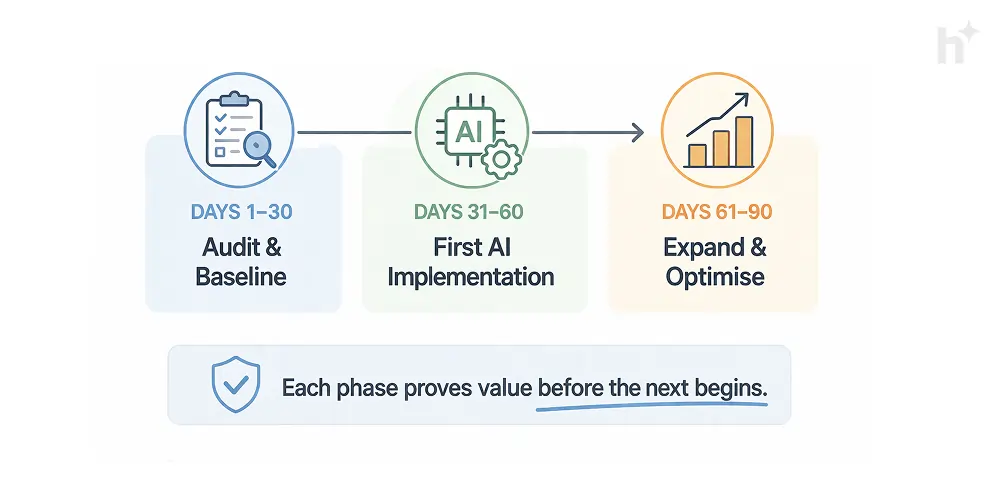
A 90-day phased rollout (Audit → First Implementation → Expand and Optimise) outperforms big-bang deployments because each phase produces data that informs the next.
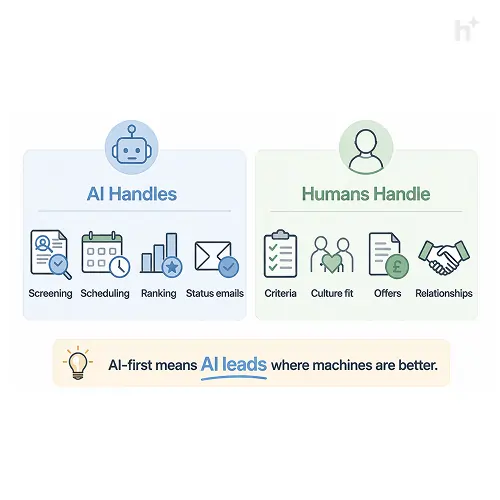
AI should handle high-volume, pattern-based tasks: resume parsing, candidate ranking, interview scheduling, and feedback collection. Human recruiters should handle relationship-based tasks: candidate engagement, cultural fit assessment, and offer negotiation.
Compliance isn’t optional. Every AI tool used in hiring must be auditable for bias, and your strategy must include a monitoring and review cycle from day one, not as an afterthought.
The companies getting the best results aren’t the ones with the most AI tools. They’re the ones with the clearest framework for what AI does and what humans do at each pipeline stage.
An AI-first recruitment strategy is a structured plan for integrating artificial intelligence into each stage of your hiring pipeline, with clear rules for where AI leads, where humans lead, and how performance is measured at every stage.
The “AI-first” framing doesn’t mean AI replaces human judgment everywhere. It means AI is the default for tasks where machines outperform humans: processing speed, consistency, pattern recognition at scale, and 24/7 availability. Humans remain the default for tasks where context, empathy, and nuanced evaluation matter: assessing cultural fit, selling candidates on the opportunity, and making final hiring decisions.
A well-built AI recruitment strategy answers four questions:
The distinction between “using AI tools” and “having an AI strategy” matters. A team that uses AI to screen resumes but has no framework for how that screening connects to downstream evaluation, no bias monitoring, and no baseline metrics isn’t running a strategy. They’re running an experiment without controls.
📊 Key Stat: Only 18% of talent acquisition teams with AI tools in production have a documented strategy for how those tools connect across the pipeline. The other 82% are using AI in isolation, which limits the compounding benefits. — Aptitude Research, State of AI in Talent Acquisition 2024
Three forces are converging: application volumes are increasing faster than recruiter headcount, top candidates are off the market in 10 days or fewer, and regulatory scrutiny of AI in hiring is tightening. A strategy is the only way to handle all three simultaneously.
The volume problem is real and growing. According to the LinkedIn Talent Solutions 2024 Future of Recruiting report, average applications per role increased 29% year-over-year for the second consecutive year. Recruiter headcount didn’t grow at the same rate. The math doesn’t work without automation — and automation without strategy produces inconsistent results.
Speed matters more than it used to. Candidates with in-demand skills receive multiple offers. A process that takes 28 days loses candidates who received and accepted offers elsewhere between days 10 and 28. AI-assisted pipelines that move from application to offer in 14–18 days win more first-choice candidates. See how teams are achieving this in our breakdown of How Automation Reduces Time-to-Hire by 40%.
Regulatory pressure is increasing. The U.S. Equal Employment Opportunity Commission (EEOC) has published guidance on AI and automated systems in employment decisions. The EU AI Act classifies AI hiring tools as “high-risk” systems requiring human oversight and documentation. Gartner’s HR Technology adoption curve shows enterprises are moving from experimentation to formal governance frameworks. A strategy that includes compliance from day one is far cheaper than retrofitting compliance after deployment.
| Pressure | Impact Without Strategy | Impact With Strategy |
|---|---|---|
| Rising application volume | Longer screening times, recruiter burnout | Automated screening handles volume, recruiters focus on shortlisted candidates |
| Candidate speed expectations | Losing top candidates to faster competitors | AI-first pipeline delivers offers in 14-18 days |
| Regulatory scrutiny | Compliance gaps discovered after deployment | Bias monitoring and audit trail built from day one |
| Budget constraints | Scattered tool purchases with unclear ROI | Phased investment tied to measurable stage-level outcomes |
The core benefit is operational consistency at scale: every candidate is evaluated against the same criteria, every scheduling action happens within hours, and every recruiter spends their time on the 15% of the process that actually requires human skill.
Screening capacity without headcount growth. AI screening evaluates 500 applications in the time a recruiter evaluates 30. For teams running 10–20 open roles simultaneously, this eliminates the bottleneck that historically required either more recruiters or longer timelines. According to Aptitude Research, the cost of screening a single candidate with AI is roughly 1/40th the cost of manual screening.
Consistency across evaluators. Manual screening introduces variability. Recruiter A and Recruiter B reviewing the same 50 resumes will produce overlapping but different shortlists. AI screening produces the same output every time, given the same criteria. That doesn’t make it perfect, but it makes it testable, auditable, and improvable in a way that inconsistent human review isn’t.
Speed that matches candidate expectations. Self-scheduling, automated acknowledgements, and AI-led first-round interviews compress the candidate-facing timeline from weeks to days. This isn’t just an efficiency metric. It’s a candidate experience differentiator that directly affects offer acceptance rates.
Recruiter time redirected to high-value activities. When AI handles screening, scheduling, acknowledgements, and feedback reminders, recruiters spend 60-70% less time on administrative pipeline management. That time goes to candidate engagement, hiring manager consultation, and offer strategy, which are the activities that actually influence hiring outcomes.
💡 Pro Tip: Start measuring where your recruiters currently spend their time before implementing AI. A time audit across one hiring cycle will reveal that 50-65% of recruiter activity is logistics coordination rather than candidate evaluation. That’s your ROI baseline.
| Capability | Manual Process | AI-First Process |
|---|---|---|
| Resume screening (200 applicants) | 3-5 days, 1 recruiter | Under 24 hours, automated |
| Interview scheduling | 3-5 email exchanges, 2-4 days | Self-scheduling link, under 4 hours |
| First-round evaluation | Phone screen, 20-30 min per candidate | AI async interview, scored automatically |
| Candidate acknowledgement | Next business day (if at all) | Instant, automated |
| Feedback collection | Manual chasing, 3-5 days | Automated reminders, 24-hour turnaround |
The framework has three phases: Audit and Baseline (Days 1-30), First AI Implementation (Days 31-60), and Expand and Optimise (Days 61-90). Each phase produces measurable data that informs the next.
Input: Your current hiring data from the last 6–12 months — time-to-hire by stage, cost-per-hire, candidate drop-off rates, recruiter time allocation, and quality-of-hire indicators.
Process: Map your entire pipeline from job requisition approval to offer acceptance. For each stage, document who does the work, how long it takes, how many candidates are at each stage, and what the error or inconsistency rate is. Identify which stages are volume-dependent (screening, scheduling) and which are judgment-dependent (final interviews, offer decisions).
Output: A pipeline map with time-at-stage data, a recruiter time audit, and a prioritised list of stages ranked by automation potential.
Most teams find that first-round screening is the highest-priority automation target — the stage with the most candidates, the most manual time, and the highest variability between evaluators.
Before you audit, read: How AI Resume Screening Works (And How to Get It Right) — so your audit benchmarks are set correctly.
Input: The highest-priority stage from your Phase 1 audit, your existing ATS data and workflows, and your selected AI tool.
Process: Implement AI at a single stage. For most teams, this means deploying AI-led async interviews or AI resume screening for one role type first, running parallel evaluation (AI screening alongside manual screening for the same candidate pool) for 2-3 weeks, comparing results, and then switching to AI-primary screening with human review of edge cases.
Output: Stage-level performance data comparing AI-screened vs manually screened candidates. Metrics: time-at-stage reduction, shortlist quality (measured by interview-to-offer conversion), and candidate satisfaction scores.
The parallel run is critical. It gives you the data to prove (or disprove) AI effectiveness before expanding, and it builds confidence among hiring managers who are sceptical of AI-generated shortlists.
If async AI interviews are your first implementation stage: The Complete Guide to AI-Powered Interviews covers how to set scoring criteria, calibrate evaluation rubrics, and handle edge cases.
Input: Performance data from Phase 2, the next-priority stage from your Phase 1 audit, and feedback from recruiters and hiring managers.
Process: Based on Phase 2 results, expand AI to the next stage (typically scheduling or feedback automation). Simultaneously, optimise Phase 2 by adjusting screening criteria based on which AI-shortlisted candidates progressed furthest. Set up ongoing monitoring dashboards for bias, speed, and quality metrics.
Output: A multi-stage AI-augmented pipeline with documented performance data, a monitoring framework, and a clear roadmap for further expansion. At this point, you have a strategy, not just a tool.
⚠️ Watch Out: Don’t skip the parallel run in Phase 2. Teams that switch to AI-only screening without a comparison period can’t prove the AI is performing better than manual screening. That proof is essential for hiring manager buy-in and for compliance documentation.
The single most impactful practice is starting with one stage and one role type rather than attempting a full pipeline transformation at once.
Start narrow, then expand. Choosing a single role type (typically your highest-volume role) for the first AI implementation gives you clean comparison data and limits risk.
Define the human-AI boundary before launch. Every stage needs a documented answer to: “What does AI do here, and what does the human do?” Ambiguity leads to either over-reliance (AI makes decisions it shouldn’t) or under-use (recruiters duplicate AI work manually).
Build compliance into the design, not after. Bias monitoring, adverse impact analysis, and audit logging should be configured during implementation, not added retroactively.
Get hiring manager buy-in with data, not promises. Hiring managers won’t trust AI shortlists based on a vendor pitch. They’ll trust them based on seeing that AI-shortlisted candidates perform as well or better than manually shortlisted candidates in their specific context.
Train recruiters on the new workflow, not just the tool. The workflow changes more than the tool does. Recruiters need to understand their new role: reviewing AI output rather than creating first-pass shortlists, focusing on relationship-building rather than logistics.
Choosing the right tools matters before you get to training. AI Recruitment Tools: What to Look For Before Buying breaks down evaluation criteria — integrations, bias auditing capabilities, ATS compatibility, and pricing models.
| Condition | Recommended Action | Expected Outcome |
|---|---|---|
| High-volume roles (100+ applicants) | Deploy AI screening first | 60-70% reduction in screening time |
| Niche technical roles (< 20 applicants) | Use AI for sourcing and scheduling, not screening | Faster engagement without losing nuance |
| Multiple hiring managers with different standards | Standardise criteria in AI before deployment | Consistent shortlists across all managers |
| Regulated industry (finance, healthcare) | Lead with compliance framework, then select tools | Audit-ready from day one |
The most common challenge is internal resistance from recruiters and hiring managers who see AI as a threat to their role rather than a tool that amplifies their impact.
Recruiters worry that AI will replace their jobs. The reality is that AI replaces the parts of their jobs they already dislike: resume sorting, scheduling coordination, and chasing feedback. The solution is showing recruiters their time audit data and demonstrating that AI frees them to do higher-value work they’re better at and more engaged by.
Hiring managers don’t trust AI shortlists because they don’t understand how the AI evaluates candidates. The solution is transparency: show managers the scoring criteria, run a parallel evaluation period, and present comparison data. Managers who see that AI-shortlisted candidates have equal or better interview outcomes become advocates.
AI screening is only as good as the job criteria it’s screening against. If your job descriptions are vague, your AI screening will produce vague results. The solution is investing in structured, skills-based job criteria before deploying AI screening. This investment pays off in manual screening quality too.
Teams don’t know what regulations apply to AI in hiring in their jurisdiction. The solution is simple: build in bias monitoring and audit trails regardless of current regulation. The direction of regulation is clear (more scrutiny, not less), and the cost of building compliance in from the start is a fraction of the cost of retrofitting.
Teams buy too many AI tools that don’t integrate well, creating a fragmented tech stack. The solution is choosing a platform that covers multiple stages rather than point solutions for each stage, or ensuring any point solutions integrate with your ATS through documented APIs.
The teams seeing the strongest results are those that followed a phased approach, starting with one high-volume stage and expanding based on measured outcomes.
Enterprise IT Staffing, 500+ Roles Per Quarter. A large IT staffing firm with 12 recruiters was spending 65% of recruiter time on screening and scheduling for contract roles. Industry: IT staffing. Problem: recruiter capacity capped at 40 roles per recruiter per quarter, creating a hiring ceiling. Intervention: deployed AI screening for all contract roles (Phase 1), then added self-scheduling (Phase 2) over 90 days. Measured Outcome: recruiter capacity increased from 40 to 65 roles per quarter (63% increase) without adding headcount. Time-to-hire dropped from 26 days to 15 days.
Mid-Market SaaS, Series B. A 150-person SaaS company scaling from 150 to 300 employees in 12 months. Industry: B2B SaaS. Problem: two recruiters couldn’t keep up with 25 simultaneous open roles across engineering, sales, and customer success. Intervention: implemented AI-first screening and async AI interviews for all roles, with parallel manual screening for the first 4 weeks. Measured Outcome: screening time dropped from 5 days to 8 hours per role. Quality held steady: interview-to-offer conversion stayed at 22%, consistent with the manual baseline.
Financial Services Graduate Programme. A UK bank running an 800-candidate annual graduate intake. Industry: financial services. Problem: 19-day screening phase with significant evaluator inconsistency (inter-rater reliability of 0.4). Intervention: replaced manual screening with AI-scored async interviews calibrated against top-performer profiles. Measured Outcome: screening compressed from 19 days to 4 days. Inter-rater consistency improved to 0.85. First-year performance correlation between AI score and actual performance: 0.71, up from 0.42 with manual scoring.
💡 Standout Result: The financial services graduate programme achieved a 79% reduction in screening time while simultaneously improving predictive accuracy. That’s the outcome when AI is applied to a high-volume, consistency-dependent stage with a clear performance baseline.
The single most important metric is stage-level time reduction, because it tells you exactly where AI is creating value and where manual bottlenecks remain.
Time-at-Stage (per pipeline stage). The number of days candidates spend at each stage. Overall time-to-hire masks stage-level bottlenecks. Calculation: (date candidate exited stage) minus (date candidate entered stage), averaged across all candidates. Target: 50%+ reduction at AI-automated stages within the first 60 days.
Screening Throughput. The number of candidates screened per day or per recruiter. Calculation: total candidates screened ÷ number of screening days. Target: 5–10x increase in throughput within 30 days of deployment.
Shortlist Quality (Interview-to-Offer Conversion). The percentage of shortlisted candidates who receive an offer. Calculation: (offers extended ÷ candidates interviewed) × 100. Target: equal to or better than manual screening baseline (typically 15–25%).
Candidate Drop-off Rate. The percentage of candidates who exit the pipeline before completion. Calculation: (candidates who dropped off ÷ total candidates who entered stage) × 100. Target: 10–20% reduction vs. manual baseline.
Adverse Impact Ratio. The pass rate of the lowest-performing demographic group divided by the pass rate of the highest-performing group. Required for regulatory compliance per EEOC guidance. Calculation: lowest group pass rate ÷ highest group pass rate. Target: 0.80 or above (the four-fifths rule).
Cost-per-Hire. Total recruiting spend divided by number of hires. Calculation: (total internal costs + total external costs) ÷ total hires. Target: 20–30% reduction within the first year.
| Metric | What It Measures | How to Calculate | Target Benchmark |
|---|---|---|---|
| Time-at-Stage | Stage-level pipeline speed | (Exit date – Entry date) averaged | 50%+ reduction at AI stages |
| Screening Throughput | AI screening capacity | Candidates screened ÷ days | 5-10x increase |
| Interview-to-Offer Conversion | Shortlist accuracy | (Offers ÷ Interviews) × 100 | ≥ manual baseline |
| Candidate Drop-off Rate | Pipeline experience quality | (Drop-offs ÷ Stage entrants) × 100 | 10-20% reduction |
| Adverse Impact Ratio | Fairness and compliance | Lowest group pass rate ÷ Highest | ≥ 0.80 |
| Cost-per-Hire | Financial ROI | (Total costs) ÷ Total hires | 20-30% reduction |
The highest-severity risk is deploying AI screening without bias monitoring, because it can systematically disadvantage candidate groups at scale before anyone notices.
Bias at scale. AI screening that contains bias doesn’t just affect one hiring decision. It affects every decision it touches. A biased manual screener might review 30 resumes. A biased AI screening tool reviews 3,000. The harm scales with the automation. Bias monitoring from day one isn’t optional.
⚠️ Critical Risk: An AI screening tool that passes 60% of Group A candidates and 40% of Group B candidates violates the four-fifths rule (0.40/0.60 = 0.67, below the 0.80 threshold). At scale, this creates systematic adverse impact that’s both legally risky and ethically unacceptable. The EEOC’s guidance on AI in hiring provides the framework for what constitutes adverse impact under existing employment law.
Over-automation of judgment calls. Some hiring decisions require context that AI can’t access: a career break explained by caregiving, a non-traditional background that signals resilience, a culture fit signal that exists in conversation but not on a resume. Automating these decisions produces false negatives that are invisible in aggregate metrics.
Vendor lock-in. AI tools that don’t export data cleanly create dependency. If your screening data, candidate scores, and historical evaluation data are trapped in a vendor’s system, switching tools means losing institutional knowledge.
Measurement neglect. Teams that implement AI without stage-level metrics can’t prove the AI is working. Without proof, budget holders cut the investment at the first sign of pressure. Without proof, hiring managers revert to manual processes. Measurement isn’t optional.
The most important near-term trend is the convergence of screening, interviewing, and assessment into unified AI evaluation platforms that provide a single candidate score across multiple evaluation types. According to Gartner’s HR Technology adoption curve, enterprises are accelerating movement from isolated AI tools toward integrated hiring intelligence platforms.
Unified evaluation platforms. Today, most teams use separate tools for resume screening, interview scheduling, and assessment. The next generation of AI hiring platforms will merge these into a single evaluation layer where resume data, interview performance, and assessment results feed into one composite candidate score. This reduces tool fragmentation and improves evaluation consistency.
Skills-based hiring acceleration. AI is making skills-based hiring operationally feasible. Historically, evaluating candidates on skills rather than credentials was slower and more expensive than credential-based screening. AI screening that evaluates demonstrated skills (from portfolios, async interview responses, and work samples) makes skills-based hiring the faster path — not the slower one.
Regulatory standardisation. The EU AI Act, New York City’s Local Law 144, and EEOC guidance are early signals of a global trend toward mandatory bias auditing for AI hiring tools. Companies building compliance infrastructure now will have a competitive advantage when broader regulation arrives.
Predictive analytics for hiring planning. AI that predicts hiring needs based on attrition patterns, business growth data, and market signals will move recruiting from reactive (“we need to fill this role”) to proactive (“we’ll need 12 engineers in Q3 based on current churn and product roadmap”). The LinkedIn Talent Solutions Future of Recruiting research points to workforce planning AI as the next major investment area for talent acquisition leaders.
Most teams can complete the three-phase framework (Audit, First Implementation, Expand) in 90 days. The audit phase takes 3-4 weeks. The first implementation takes 4-6 weeks including the parallel run period. Expansion begins immediately after Phase 2 data is validated. Teams with clean ATS data and strong hiring manager relationships move faster.
No. The 90-day framework was designed for teams of 2-5 recruiters. Smaller teams often see proportionally larger benefits because they have less capacity to absorb volume increases without automation. A two-person recruiting team handling 25 roles will reclaim more proportional time from AI screening than a 15-person team handling the same volume.
Tool costs vary, but the more significant investment is time: the audit phase, the parallel run, and the training. Budget for 30-40 hours of recruiter time for the audit and parallel evaluation, plus tool subscription costs that typically range from $200-$800 per month for mid-market teams. ROI typically appears within the first 60 days.
Data. Run a parallel evaluation where the AI and the hiring manager’s preferred recruiter both screen the same candidate pool. Compare which shortlist produces better interview outcomes. In most cases, the AI-generated shortlist performs equally or better, and that data converts sceptics into advocates.
Yes, but with different AI insertion points. For roles with fewer than 20 applicants, AI screening adds less value because the volume advantage is small. For these roles, AI is better applied to sourcing (identifying passive candidates), scheduling, and feedback collection. The strategy framework is the same; the specific stages where AI leads are different.
At minimum: document your AI tool’s scoring methodology, establish a bias audit cadence (quarterly is standard), capture baseline demographic data for adverse impact analysis, and ensure your tool can produce an audit trail that shows how each candidate was evaluated. Check jurisdiction-specific requirements — NYC Local Law 144, EU AI Act — for additional obligations. The EEOC’s guidance on automated employment decision tools is required reading before deployment.
When implemented well, it improves candidate experience. Candidates get faster acknowledgements, more flexible scheduling, and quicker decisions. The risk is when AI communication feels impersonal or when candidates don’t understand how they’re being evaluated. Transparency about AI usage in the process, clear communication at each stage, and a human touchpoint for questions mitigate this risk.
Building an AI recruitment strategy from scratch requires a phased approach, not a tool shopping spree. The 90-day framework — Audit, Implement, Expand — works because each phase produces the data that justifies the next.
The tension is real: AI creates speed and consistency, but it also creates compliance obligations and requires a clear human-AI boundary at every stage. The teams that get this right aren’t the ones with the biggest budgets or the most tools. They’re the ones with the clearest framework for what AI handles, what humans handle, and how performance is measured at every point.
If you’re starting from zero, start with the audit. Map your pipeline, time each stage, and find the manual bottleneck that AI can remove fastest. That’s your first 30 days. The next 60 follow from there.
hiremore AI provides the AI screening and async interview layer that most teams deploy first, because first-round screening is the stage with the highest volume, the most manual effort, and the fastest measurable ROI.
Ready to hire smarter?
Build structured pipelines, screen candidates with AI, and keep your team aligned from first application to final offer.
