



How to Write Job Descriptions That Attract the Right Candidates


The average job posting now receives 340 applicants. That’s a 182% increase from 2021, according to recruitment platform Ashby. Yet most job descriptions still read like compliance documents: dense, jargon-heavy, and completely silent on the things candidates actually care about. A job description is the structured document that defines a role’s responsibilities, requirements, compensation, and working conditions for prospective candidates. It’s your first conversation with future hires, and for most applicants, it’s also your last chance to make an impression.
This guide is for hiring managers, recruiters, and talent acquisition leaders who want to write job descriptions that do more than fill an open requisition. You’ll get a repeatable framework for structuring, writing, and measuring job postings that consistently attract qualified, engaged candidates.
If your current job descriptions aren’t converting the right people, the problem isn’t your employer brand or your budget. It’s probably your copy.
Key Takeaways
- Job descriptions under 300 words receive 8.4% more applications than longer postings, but the sweet spot for qualified applicants is 300 to 700 words.
- Gender-neutral job descriptions receive up to 42% more responses than postings with heavily gendered language.
- 72% of job seekers say they’re less likely to apply when a posting doesn’t include a salary range.
- Structured job descriptions with clear sections (title, summary, responsibilities, requirements, compensation) consistently outperform unstructured text blocks in apply rates.
- The five metrics that matter most for job description performance are: apply rate, qualified applicant ratio, time-to-first-applicant, bounce rate, and diversity index.
- Posting timing matters: applications peak on Mondays and Tuesdays, so publishing early in the week maximizes initial visibility.
What Are Effective Job Descriptions?
Effective job descriptions are structured documents that clearly communicate a role’s purpose, responsibilities, requirements, and compensation in language that resonates with the target candidate, not just the hiring committee.
The gap between a job description that fills a role in 18 days and one that sits open for 60 is rarely about the job itself. It’s about how the job is presented. An effective job description does three things simultaneously: it attracts the right candidates, filters out poor fits before they apply, and gives search engines and job boards enough structure to surface the posting to the right audience.
Most hiring teams treat job descriptions as internal documents that happen to be public. They copy responsibilities from the last time the role was open, add a few bullet points from the hiring manager’s wishlist, and post it without a second look. That approach worked when candidates had fewer options. It doesn’t work when the average job seeker submits 32 to 200 applications before landing an offer.
What separates high-performing job descriptions from the rest isn’t length or creativity. It’s structure, specificity, and an honest answer to the candidate’s real question: “Is this worth my time?”
| Element | Weak Job Description | Strong Job Description |
|---|---|---|
| Job Title | “Marketing Ninja” | “Senior Content Marketing Manager” |
| Requirements | 15+ bullet points, most non-essential | 5 must-haves clearly separated from nice-to-haves |
| Compensation | “Competitive salary” | “$95,000 to $120,000 base + 10% annual bonus” |
| Structure | Wall of text | Scannable sections with headers |
| Language | Jargon-heavy, gendered | Clear, inclusive, candidate-focused |
Why Job Descriptions Matter in Modern Hiring
Job descriptions are the single highest-volume touchpoint in your hiring funnel, and their quality directly determines who applies, who bounces, and how long it takes to fill a role.
Think about the math. If your company posts 50 roles per quarter and each posting gets viewed 500 times, that’s 25,000 candidate impressions every three months. Your job descriptions are doing more brand communication than most marketing campaigns, and they’re usually written by someone who spent 15 minutes on them between meetings.
The downstream effects are measurable. A poorly written job description doesn’t just attract fewer applicants. It attracts the wrong ones. When unqualified candidates flood your pipeline, recruiters spend hours screening people who never should have applied. When qualified candidates bounce because the posting was vague or off-putting, you lose people who would have been strong hires.
📊 Key Stat: 72% of candidates say they’re less likely to apply when a job posting doesn’t list salary information, and 67% have suspected a job posting was fake, misleading, or never intended to be filled (Resume Genius, 2026).
The cost compounds. Every additional day a role stays open costs companies an estimated $500 per day in lost productivity. For a role that takes 60 days to fill instead of 30, that’s $15,000 in hidden cost before you’ve even made a hire.
📊 Job Descriptions by the Numbers
- 340: Average number of applicants per job posting in 2025, a 182% increase from 2021 (Ashby)
- 14.6 seconds: Average time a candidate spends reading the requirements section of a job description
- 8.4%: Increase in application responses for job descriptions under 300 words (LinkedIn Talent Solutions)
- 42%: More responses for job descriptions using gender-neutral language versus gendered terms (Appcast Gender Report)
- 72%: Candidates less likely to apply when no salary range is listed (Resume Genius, 2026)
- 60%: Job postings on Indeed that now include salary ranges, attracting 30% more applicants (Indeed Hiring Lab)
Key Benefits of Well-Written Job Descriptions
Well-written job descriptions reduce time-to-fill, improve applicant quality, strengthen employer branding, and lower cost-per-hire by attracting candidates who are genuinely qualified and genuinely interested.
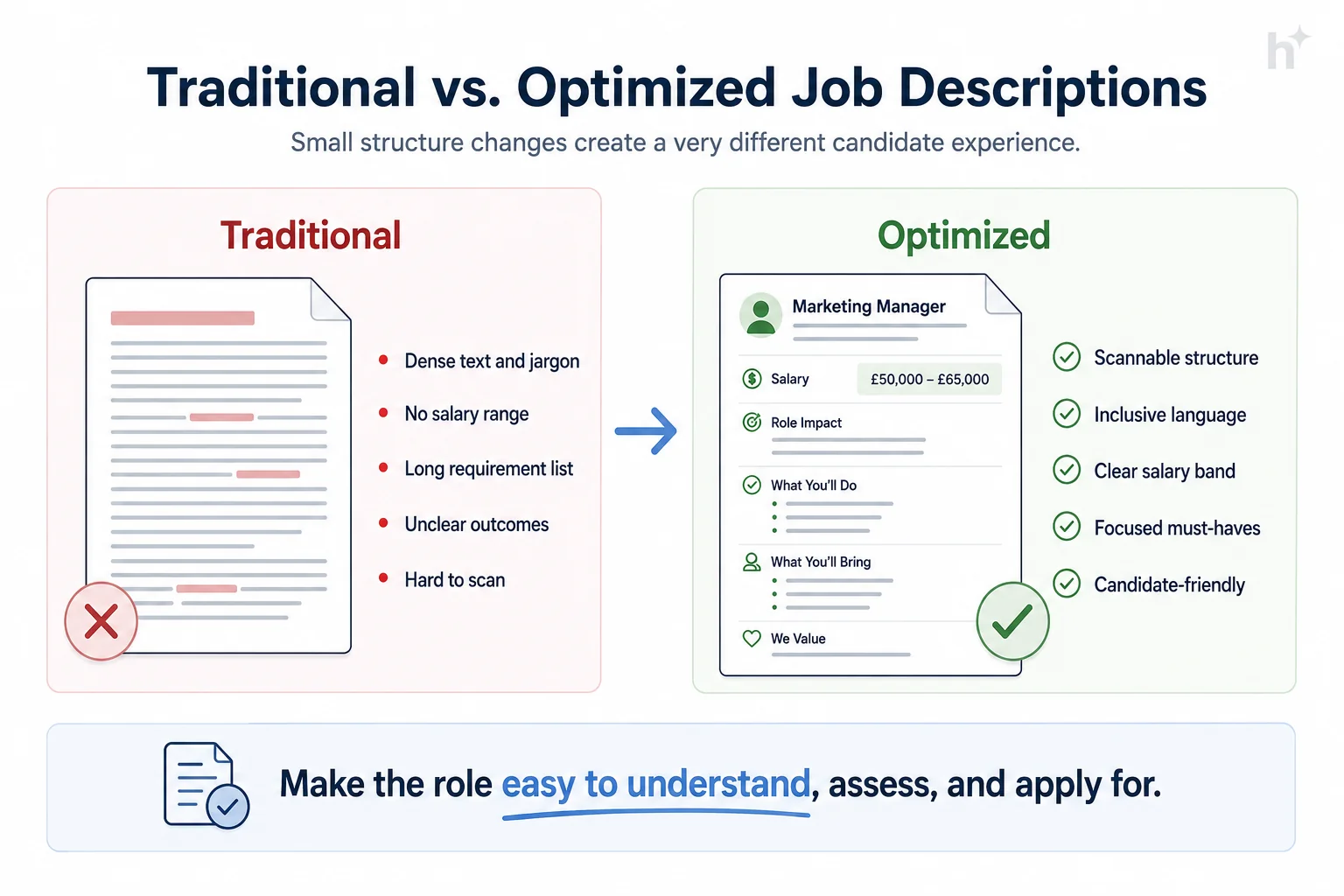
Higher qualified applicant ratio. When your job description clearly separates must-have requirements from nice-to-haves, candidates can self-select accurately. Organizations that restructured their requirements sections saw qualified applicant rates increase by 20 to 30%.
Faster time-to-fill. Clear, compelling job descriptions generate applications faster. When candidates understand the role, the team, and the compensation upfront, they apply with confidence. That cuts back-and-forth and moves hiring forward.
Stronger employer brand. Every job posting is a brand impression. A well-structured posting with transparent compensation, honest role descriptions, and inclusive language tells candidates your company respects their time. 88% of candidates say employer branding influences their decision to apply. A strong job description is also the foundation of a strong career page — see our guide on how to build a career page that converts top candidates for how to carry that impression through the full application experience.
Lower screening costs. When unqualified candidates don’t apply because the description was clear about requirements, your recruiting team spends less time on manual screening. One mid-sized tech company reduced its resume screening workload by 35% after rewriting 40 job descriptions with a structured template. Pair this with recruitment automation to remove the remaining manual bottlenecks from screening through to offer.
| Benefit | Without Optimization | With Optimization |
|---|---|---|
| Apply Rate | 2-4% | 6-11% |
| Qualified Applicant Ratio | 15-25% | 40-55% |
| Time-to-Fill | 45-65 days | 25-38 days |
| Cost-per-Hire | $4,700+ | $3,200-$3,800 |
| Candidate NPS | Low (passive dissatisfaction) | High (active advocacy) |
💡 Pro Tip: If you’re writing job descriptions at scale across multiple roles and departments, look for platforms that let you template, score, and optimize postings from a central system. hiremore AI, for example, lets teams standardize job description workflows alongside their broader hiring pipeline, so every posting follows the same quality framework without bottlenecking individual hiring managers.
How to Write Job Descriptions That Attract the Right Candidates
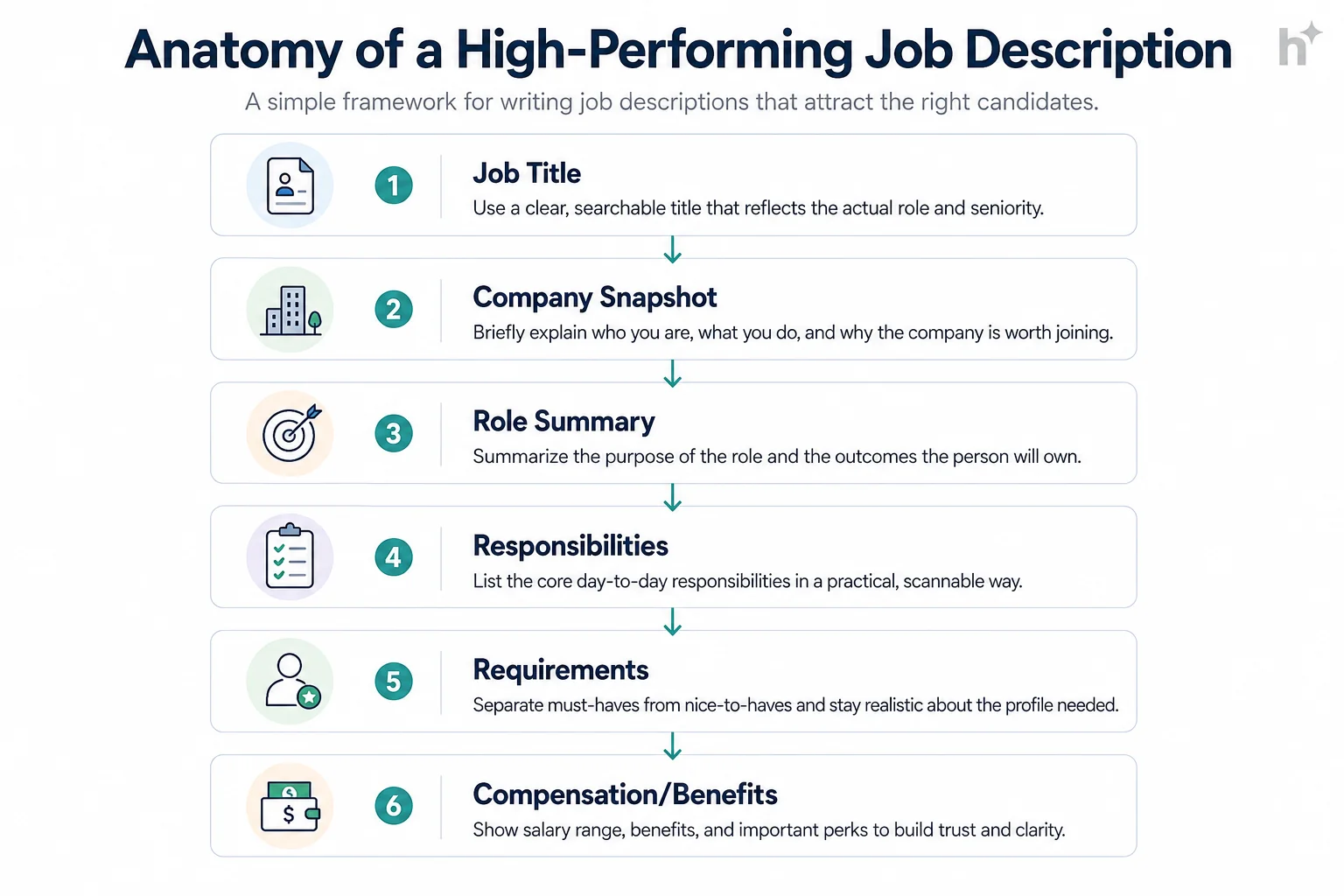
Writing effective job descriptions follows a six-stage process: define the role clearly, structure the content for scannability, write in candidate-focused language, optimize for search, include compensation details, and review for bias and clarity before publishing.
Stage 1: Define the Role with the Hiring Manager
Input: Hiring manager’s requirements, team context, growth trajectory for the role, budget for the position.
Process: Conduct a 30-minute intake meeting. Ask the hiring manager to describe the role’s top three priorities in the first 90 days, the skills that are truly non-negotiable versus aspirational, and what success looks like at the six-month mark. Don’t accept a recycled description from two years ago.
Output: A role brief that captures the actual job, not a wishlist. This brief becomes the foundation for the job description.
Stage 2: Structure the Content for Scannability
Input: Role brief from Stage 1, your company’s job description template.
Process: Organize the content into six clearly labeled sections: Job Title, Company Snapshot (2 to 3 sentences about the team and mission), Role Summary (what the person will do and why it matters), Responsibilities (5 to 8 bullet points), Requirements (must-haves separated from nice-to-haves), and Compensation and Benefits (salary range, perks, working model).
Output: A structured document that candidates can scan in under 60 seconds and still understand the essentials.
Stage 3: Write in Candidate-Focused Language
Input: Structured content from Stage 2.
Process: Rewrite every section from the candidate’s perspective. Replace “The ideal candidate will…” with “You’ll…” or “In this role, you’ll…” Cut jargon. Remove internal acronyms. Use active voice. Keep sentences short. Read it out loud. If it sounds like a legal filing, rewrite it.
Output: A posting that reads like a conversation, not a contract.
Stage 4: Optimize for Search and Job Boards
Input: Draft job description, target job title keywords.
Process: Place the primary job title keyword in the title, first paragraph, and at least two subheadings. Avoid creative titles like “Marketing Rockstar” because candidates don’t search for them and neither do job board algorithms. Use standard titles: “Senior Product Manager,” “Staff Software Engineer,” “HR Business Partner.” Keep titles under 25 characters for mobile readability.
Output: A search-optimized posting that surfaces in job board results and Google for Jobs. Once your posting is optimized, the next step is getting it in front of as many relevant candidates as possible — read our guide on automated job posting and how to syndicate across boards efficiently to maximize reach without the manual effort.
⚠️ Watch Out: Creative job titles might seem fun internally, but they kill discoverability. A posting titled “Customer Happiness Hero” will get a fraction of the views that “Customer Support Manager” receives because nobody searches for made-up titles.
Stage 5: Include Compensation and Working Model
Input: Approved salary band, benefits package, remote/hybrid/onsite policy.
Process: Add the salary range prominently, ideally near the top of the posting. State the working model clearly: fully remote, hybrid (specify days), or onsite. List the top 3 to 5 benefits that differentiate your offer, not the generic ones every company lists.
Output: A transparent posting that builds immediate trust and pre-qualifies candidates on compensation expectations.
Stage 6: Review for Bias and Clarity
Input: Completed draft.
Process: Run the posting through a bias checker for gendered language. Remove unnecessary requirements that filter out diverse candidates (like “must have a degree” when the role can be done without one). Have someone outside the hiring team read it and tell you what they think the job actually is. If they can’t, rewrite.
Output: A clean, inclusive, ready-to-publish job description.
| Stage | Time Investment | Impact |
|---|---|---|
| Role Definition | 30 minutes | Prevents 80% of “wrong candidate” problems |
| Content Structure | 20 minutes | Increases scan-through rate by 3x |
| Language Rewrite | 30 minutes | Improves apply rate by 15-25% |
| SEO Optimization | 15 minutes | Increases job board visibility by 30-50% |
| Compensation Transparency | 10 minutes | Attracts 30% more applicants |
| Bias Review | 15 minutes | Expands candidate pool by 20-42% |
Best Practices for Job Description Writing
The single most impactful practice is separating must-have requirements from nice-to-haves, because inflated requirements lists are the number one reason qualified candidates don’t apply.
Keep requirements lists to 5 must-haves. Before: A posting lists 15 requirements including “10+ years of experience,” “MBA preferred,” and “expert in 6 software tools.” After: The same posting lists 5 non-negotiable skills and labels 3 additional skills as “nice-to-have.” Result: 34% increase in applications from qualified candidates, including a more diverse applicant pool.
Lead with impact, not tasks. Before: “Responsible for managing social media accounts and creating content calendars.” After: “You’ll own our social presence across four channels, shaping how 200,000 followers experience our brand every day.” Result: 22% higher application completion rate because candidates could see the role’s significance.
⚠️ Watch Out: The biggest mistake in job description writing isn’t bad grammar. It’s listing “requirements” that aren’t actually required. LinkedIn Talent Solutions research shows women apply when they meet 100% of listed requirements, while men apply at 60%. Every unnecessary requirement you add disproportionately shrinks your female applicant pool.
Include salary ranges in every posting. Before: “Competitive compensation package.” After: “$85,000 to $110,000 base salary plus equity and annual bonus.” Result: 30% more applications and a 40% reduction in offer negotiation time because expectations were aligned from day one.
Write for mobile screens first. Before: Dense paragraphs with 8-line blocks of text. After: Short paragraphs (2 to 3 sentences), clear section headers, bullet points for responsibilities. Result: 25% lower bounce rate on mobile job views, where over 60% of candidates first encounter your posting.
Use second person (“you”) instead of third person. Before: “The successful candidate will be expected to manage a team of five.” After: “You’ll lead a team of five engineers, setting priorities and removing blockers.” Result: Higher engagement time on posting pages and stronger apply intent.
| Condition | Recommended Action | Expected Outcome |
|---|---|---|
| 100+ applicants expected | Use strict must-have/nice-to-have split | Higher qualified ratio, less screening time |
| Niche technical role | Describe problems to solve, not tools to know | Attracts experienced engineers who learn fast |
| Remote-eligible role | State time zone, async expectations, equipment policy | Filters for candidates who thrive in remote settings |
| Entry-level position | Focus on skills and aptitude, drop degree requirements | 20-30% broader, more diverse applicant pool |
| Executive hire | Lead with business impact and decision authority | Attracts senior leaders, not task-oriented managers |
Common Challenges and How to Solve Them
The most common challenge is that job descriptions are written by committee, producing watered-down postings that try to please every stakeholder and end up resonating with no one.
Challenge: Too Many Cooks in the Kitchen
Hiring managers want technical depth. HR wants compliance language. Legal wants disclaimers. The result is a 1,200-word document that reads like it was written by four different people, because it was. The fix: assign one owner per job description. That person collects input from stakeholders, writes the draft, and makes final calls on language and structure. Others can review, but one voice writes.
Challenge: Recycled Descriptions from Years Ago
Teams reuse old job descriptions because writing new ones takes time. But a description from 2022 doesn’t reflect 2026 market expectations around salary transparency, remote work, or skills-based hiring. The fix: treat every new opening as a fresh brief. Start from your template, run a 30-minute intake with the hiring manager, and update the compensation range and working model at minimum.
Challenge: Requirements Inflation
Hiring managers add “nice-to-have” skills to the required list because they want the best possible candidate. The result is a posting that only someone with 15 years of experience and three degrees would qualify for, even though the role could be done by someone with five years and strong learning ability. The fix: force a hard split. Limit must-haves to five items. Everything else goes under a clearly labeled “preferred” section.
Challenge: Invisible Bias in Language
Most bias in job descriptions isn’t intentional. Words like “aggressive,” “rockstar,” and “dominant” signal a culture that may not welcome diverse candidates. Research from Adzuna found that 60% of businesses showed significant male bias in their job posting language. The fix: run every posting through a gender decoder or bias-checking tool before publishing. Replace gendered terms with neutral alternatives like “driven,” “collaborative,” or “detail-oriented.” SHRM’s inclusive hiring guidelines provide a useful framework for auditing job description language against established best practices.
Challenge: Poor Mobile Readability
Over 60% of candidates first see your job posting on a mobile device. Dense text blocks, tables that don’t resize, and long scroll depths kill engagement. The fix: structure every posting for a 375-pixel-wide screen. Use short paragraphs, clear headers, and bullet points. Test the posting on your phone before publishing.
Real-World Use Cases
Organizations that restructure their job descriptions around clear frameworks consistently see 25 to 40% improvements in apply rates and qualified applicant ratios within the first quarter.
Healthcare staffing firm, 500+ annual hires. Problem: Nursing job descriptions were 900+ words, listing 18 requirements including certifications that were only relevant in specific states. Intervention: Reduced each posting to 400 words with 5 must-haves and state-specific requirements in a dropdown section. Measured Outcome: 38% increase in completed applications and a 15-day reduction in average time-to-fill for RN positions.
SaaS company, Series B, engineering team. Problem: Software engineer postings used internal project codenames and required specific tool experience (e.g., “must know Terraform, Datadog, and PagerDuty”) rather than describing problems. Intervention: Rewrote postings to describe the engineering challenges candidates would solve, with tools listed as “nice-to-have” context. Measured Outcome: 45% increase in applications from senior engineers and a 28% improvement in interview-to-offer conversion.
Retail chain, 200 locations, high-turnover roles. Problem: Store associate job descriptions hadn’t been updated in three years and contained no salary information. Intervention: Added salary ranges, simplified language to an 8th-grade reading level, and included shift schedule details upfront. Measured Outcome: 52% more applications per posting and a 20% drop in first-week attrition because candidates knew what to expect.
💡 Pro Tip: The highest-impact change you can make to any job description isn’t a language rewrite. It’s adding the salary range. That single addition consistently produces the largest jump in application volume across every industry and role level.
Government agency, diversity hiring initiative. Problem: Job descriptions for administrative roles used formal, jargon-heavy language and required a bachelor’s degree for positions that didn’t need one. Intervention: Removed degree requirements, replaced formal language with plain English, and added an explicit diversity commitment statement. Measured Outcome: 33% increase in applications from underrepresented groups and no decrease in candidate quality as measured by hiring manager satisfaction scores.
Metrics to Track Job Description Success
The single most important metric is qualified applicant ratio, because high application volume means nothing if the candidates aren’t the right fit.
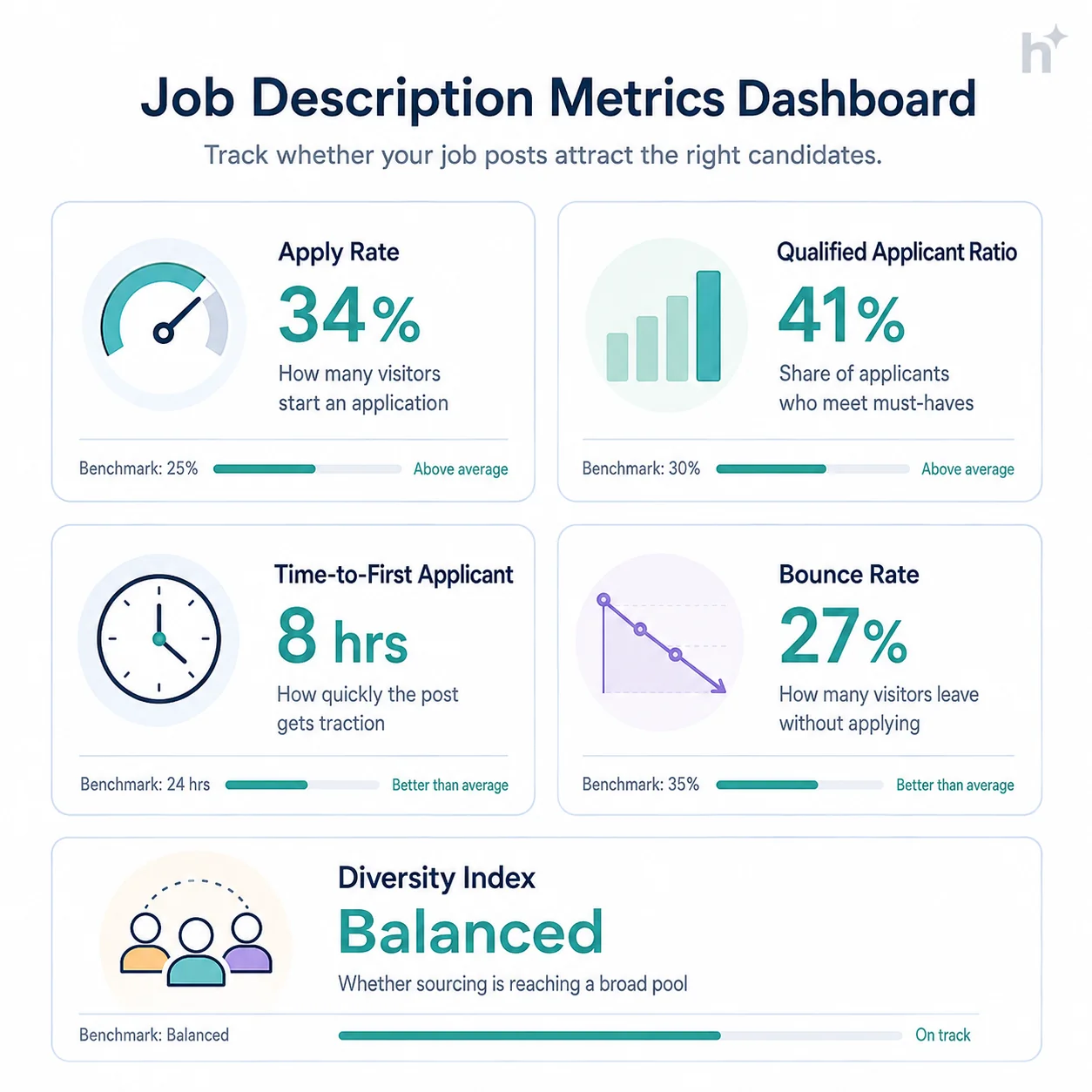
Apply rate. Definition: The percentage of people who view your job posting and actually submit an application. Calculation: (Total applications / Total posting views) x 100. Target Benchmark: 8 to 11% for well-optimized postings. Industry average sits around 3 to 5%.
Qualified applicant ratio. Definition: The percentage of total applicants who meet the minimum qualifications for the role. Calculation: (Qualified applicants / Total applicants) x 100. Target Benchmark: 40 to 55%. If you’re below 25%, your job description is attracting the wrong audience.
Time-to-first-applicant. Definition: How quickly the first application arrives after posting. Calculation: Time elapsed from posting going live to first application received. Target Benchmark: Under 24 hours for most roles. If it’s taking 3+ days, the posting isn’t reaching the right candidates or isn’t compelling enough to drive immediate action.
Bounce rate. Definition: The percentage of candidates who open the job posting but leave without scrolling or applying. Calculation: (Sessions with no interaction / Total sessions) x 100. Target Benchmark: Under 40%. High bounce rates indicate the title attracted clicks but the content didn’t hold attention.
Diversity index. Definition: The demographic spread of your applicant pool compared to the available labor market. Calculation: Compare applicant demographics against local or industry labor market data. Target Benchmark: Applicant pool demographics should approximate or exceed the available talent market for the role category.
| Metric | What It Measures | How to Calculate | Target |
|---|---|---|---|
| Apply Rate | Posting-to-application conversion | (Applications / Views) x 100 | 8-11% |
| Qualified Applicant Ratio | Applicant quality | (Qualified / Total) x 100 | 40-55% |
| Time-to-First-Applicant | Posting urgency and reach | Hours from live to first apply | Under 24 hrs |
| Bounce Rate | Posting engagement | (No-interaction sessions / Total) x 100 | Under 40% |
| Diversity Index | Applicant pool representation | Demographics vs. labor market | ≥ Market parity |
Risks and Pitfalls
The highest-severity risk is legal exposure from discriminatory language or non-compliant postings, which can result in regulatory penalties and reputational damage that’s far more expensive than the time it takes to review a job description.
⚠️ Watch Out: In many jurisdictions, pay transparency in job postings is now legally required, not optional. As of 2026, states including Colorado, California, New York, Washington, and Illinois mandate salary ranges in job postings. Non-compliance can result in fines ranging from $1,000 to $250,000 depending on the jurisdiction and number of violations. The Bureau of Labor Statistics tracks wage and labor market data by state, and SHRM maintains updated compliance guidance for HR teams navigating these requirements.
Discriminatory language exposure. Using requirements like “recent graduate” (age discrimination), “native English speaker” (national origin discrimination), or “must be able to stand for 8 hours” without verifying it’s a genuine occupational requirement can trigger EEOC complaints. Review every posting against your jurisdiction’s protected categories.
Overpromising and underdelivering. Writing an aspirational job description that doesn’t match the actual role creates a bait-and-switch experience. Candidates who accept offers based on inflated descriptions leave faster. First-year attrition for roles with misleading job descriptions runs 25 to 35% higher than average.
Keyword stuffing in job titles. Adding location tags, seniority levels, and buzzwords to job titles (“Senior Staff Software Engineer III, Remote, AI/ML, Bay Area”) might seem like good SEO. In practice, it looks spammy, confuses candidates, and can trigger job board penalties that reduce your posting’s visibility.
Ignoring mobile formatting. Publishing a posting that looks clean on desktop but breaks on mobile means 60%+ of your potential applicants see a wall of unformatted text. This isn’t a design preference. It’s a conversion killer.
Future Trends in Job Description Writing
The most significant near-term trend is AI-assisted job description generation and optimization, which is already being used by over 38% of hiring teams to draft, score, and improve postings before they go live.
AI-powered writing assistance. Tools that score job descriptions for readability, inclusivity, and SEO before publishing are moving from early adoption to mainstream. These platforms analyze language patterns against performance data from millions of postings and suggest specific edits that improve conversion. The trend isn’t replacing writers, it’s giving them a real-time feedback loop.
Skills-based job descriptions. The shift from credential-based requirements (“must have a bachelor’s degree”) to skills-based requirements (“must be able to build and maintain CI/CD pipelines”) is accelerating. Companies like Google and IBM have already removed degree requirements from most postings, and mid-market firms are following.
Dynamic job descriptions. Static, one-size-fits-all postings are giving way to descriptions that adapt based on the candidate’s location, career level, or browsing context. A senior candidate might see emphasis on leadership scope and strategic impact, while a mid-level candidate sees growth trajectory and mentorship access. These dynamic postings work best when paired with a passive talent pipeline — reaching candidates who haven’t started actively searching yet but are the right fit for a role.
Embedded compensation intelligence. As pay transparency laws expand globally, job descriptions will increasingly include not just salary ranges but total compensation breakdowns, equity projections, and benefits calculators embedded directly in the posting.
Frequently Asked Questions
How long should a job description be to maximize applications?
The best-performing job descriptions fall between 300 and 700 words. Postings under 300 words get 8.4% more responses than the average, but very short descriptions can lack the detail that qualified candidates need to self-select. The sweet spot is enough detail to inform without enough length to overwhelm. For most roles, aim for 400 to 600 words.
Should job descriptions include salary ranges even when not legally required?
Yes. Data consistently shows that postings with salary ranges attract 30% more applicants. Beyond volume, salary transparency reduces offer negotiation friction and aligns candidate expectations early. Even if your jurisdiction doesn’t mandate it, candidates increasingly expect it, and 72% say they’re less likely to apply without it.
How do you write job descriptions that rank higher on job boards and Google?
Use standard job titles that match what candidates actually search for. Place the title keyword in the headline, first paragraph, and at least one section header. Avoid creative titles, all-caps formatting, and keyword stuffing. Structure the posting with clear HTML headings (H1, H2, H3) so job board algorithms and Google for Jobs can parse the content accurately.
What’s the biggest mistake companies make when writing job descriptions?
Inflating requirements. Listing 12 to 15 “must-have” qualifications when only 4 or 5 are truly essential shrinks your applicant pool, especially among women and underrepresented candidates who are less likely to apply unless they meet every listed requirement. The fix is simple: separate genuine must-haves from preferred qualifications and label them clearly.
How often should job descriptions be updated or refreshed?
Review and update every job description at least quarterly, even for recurring roles. Market compensation shifts, evolving skill requirements, and changes in work model expectations (remote, hybrid, onsite) mean that a description from six months ago may already be outdated. Treat job descriptions like marketing copy, not legal documents.
Can AI tools write effective job descriptions, or do they need human editing?
AI tools are effective at generating first drafts, checking for bias, and scoring readability. But they still require human editing for accuracy, tone, and company-specific context. The best workflow is AI-assisted drafting followed by human review, especially for the role summary and culture sections where authenticity matters most.
How do inclusive job descriptions improve hiring outcomes?
Gender-neutral job descriptions receive up to 42% more responses than gendered ones. Removing unnecessary degree requirements expands the candidate pool by 20 to 30%. Adding explicit diversity statements and using plain language (8th-grade reading level) makes postings accessible to a broader talent market without reducing candidate quality.
Conclusion
Writing effective job descriptions isn’t a creative exercise. It’s a structured, measurable discipline that directly impacts who applies, how fast you hire, and how long those hires stay. The organizations that treat job descriptions as conversion tools, not compliance documents, consistently fill roles faster, attract stronger candidates, and spend less per hire.
The tension is real: hiring managers want detailed descriptions, candidates want concise ones, and legal teams want protective language. The solution isn’t choosing one audience over the others. It’s using a clear structure (title, summary, responsibilities, requirements, compensation) that serves all three without sacrificing readability.
Start with one change. Add salary ranges to your next five postings. Measure the difference. Then apply the full framework from this guide to every role you post. Your job descriptions are the top of your hiring funnel. Treat them accordingly — and when you’re ready to connect every stage from posting to offer, see how to build a scalable end-to-end hiring workflow that keeps your entire team aligned.
Ready to hire smarter?
Turn hiring insights into faster shortlists with hiremore AI.
Build structured pipelines, screen candidates with AI, and keep your team aligned from first application to final offer.