


An AI-powered ATS that simplifies shortlisting, tagging, and workflows - built for fast, scalable, and collaborative hiring.
Copyright © 2026|hiremore AI
An AI-powered ATS that simplifies shortlisting, tagging, and workflows - built for fast, scalable, and collaborative hiring.






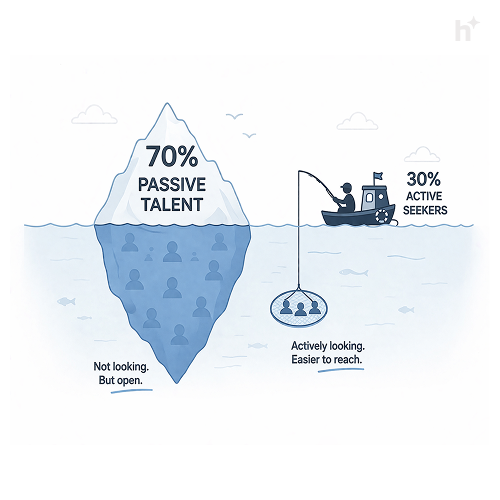
70% of the global workforce is passive talent. These are professionals who aren’t searching job boards, aren’t updating their resumes, and aren’t responding to generic recruiter messages. They’re also, overwhelmingly, the people you most want to hire. A passive talent pipeline is the system that identifies, engages, and maintains relationships with these professionals so that when a role opens, you’re not starting from zero.
The difference between companies that fill critical roles in 2 weeks and those that take 8 weeks almost always comes down to whether they had a pipeline before the requisition opened. Reactive hiring — posting a job and waiting for applicants — forces you to compete for the same active candidates everyone else is chasing. Pipeline-driven hiring means your best candidates already know you, trust you, and are ready to have a serious conversation.
This guide gives talent acquisition leaders and recruiters a repeatable system for building a talent pipeline that continuously produces qualified candidates. You’ll get specific sourcing strategies, engagement cadences, activation triggers, and the metrics that prove pipeline value to business leadership.
70% of the global workforce is passive talent. If your sourcing strategy only reaches active job seekers, you’re fishing from 30% of the available talent pool.
Organizations with pre-built talent pipelines fill roles 2-3x faster than those relying on reactive, post-and-pray hiring. The time saved compounds across every open role.
The global talent shortage could reach 85 million people by 2030, representing $8.5 trillion in unrealized revenue (Korn Ferry). Proactive pipeline building is no longer optional.
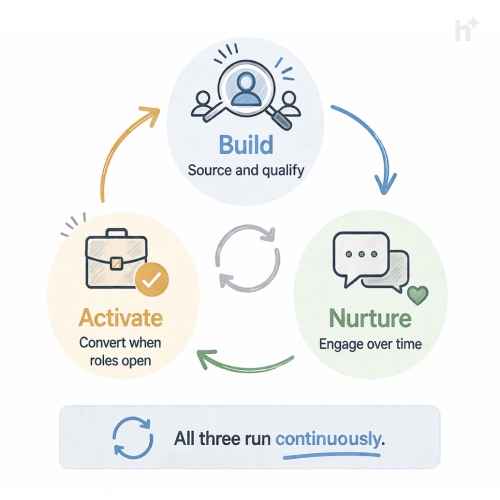
A passive talent pipeline operates in three continuous phases: Build (source and identify), Nurture (maintain engagement), and Activate (convert to applicants when roles open). All three must run simultaneously.
90% of hiring managers report difficulty sourcing skilled candidates (ManpowerGroup). The difficulty isn’t a shortage of people. It’s a shortage of relationships with the right people.
The most effective pipeline engagement cadence touches each candidate 4-6 times per year through a mix of content sharing, event invitations, and personalized career check-ins.
A passive talent pipeline is a continuously maintained pool of pre-qualified professionals who aren’t actively job searching but have been identified, engaged, and kept warm through ongoing relationship building so they can be quickly activated when relevant roles open.
This isn’t a database of names. A spreadsheet with 500 LinkedIn profiles isn’t a pipeline. It’s a list. A real pipeline implies three things: the candidates have been vetted for relevance, they know who you are and have engaged with your brand, and there’s a system for keeping the relationship active over time.
Think of it like a sales pipeline. A sales team doesn’t wait until a contract expires to start building a relationship with a potential client. They identify prospects, nurture the relationship, and position themselves so that when the buying decision happens, they’re the obvious choice. Talent pipelines work the same way.
The “passive” distinction matters because passive candidates behave differently from active job seekers. They won’t respond to generic job postings. They won’t apply through your careers page. And they won’t engage with cold outreach that reads like a mass email.
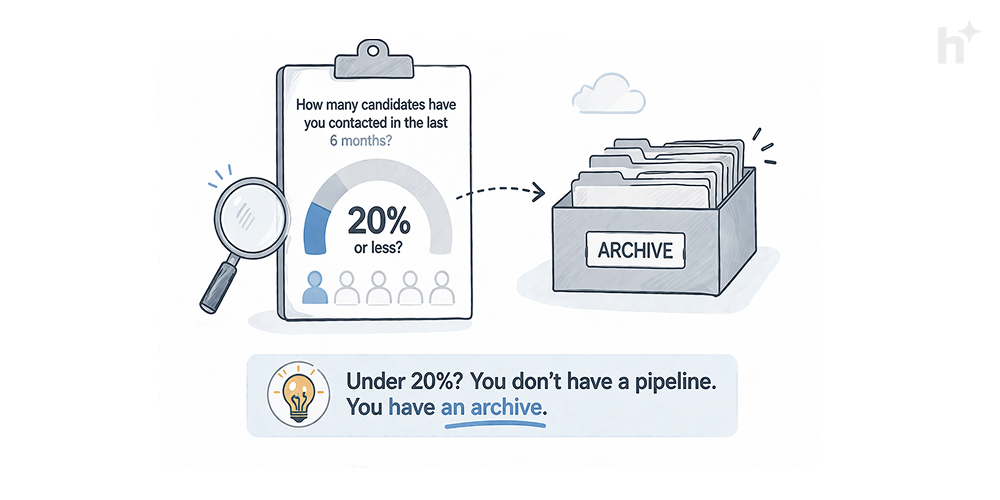
💡 Pro Tip: Audit your current “talent pipeline” right now. How many candidates in your database have you personally communicated with in the last 6 months? If the answer is less than 20%, you don’t have a pipeline. You have an archive.
Without a talent pipeline, every new hire starts from scratch. That reactive cycle adds weeks to every fill, increases cost-per-hire, and forces you to compete for the same active candidates as every other employer.
The average time-to-fill across industries sits at 43 days. For specialized technical roles, it can stretch to 60–90 days. During that vacancy period, projects stall, teams overextend, and revenue opportunities pass by. Korn Ferry projects the global talent shortage could reach 85 million people by 2030, representing $8.5 trillion in unrealized annual revenue. The World Economic Forum’s Future of Jobs Report 2025 reinforces this urgency: skills gaps are now the single biggest barrier to business transformation, with nearly 40% of required job skills set to change by 2030 and 63% of employers citing this as their primary challenge.
46% of employers cite finding qualified candidates as their biggest talent acquisition challenge. Another 68% say the top of their recruiting funnel is the weakest link. These aren’t screening problems. They’re sourcing problems. And sourcing problems are pipeline problems.
📊 Key Stat: Companies with proactive talent pipeline strategies report 50-60% faster time-to-fill compared to purely reactive hiring models. The speed advantage increases for specialized and senior roles where passive candidates dominate.
The primary benefit is hiring speed. When a role opens, you’re not searching for candidates. You’re activating relationships with people who already know your company.
Dramatically faster time-to-fill. Reactive hiring starts at zero: post the job, wait, source, screen, schedule. Pipeline-driven hiring starts at the relationship: reach out to warm candidates, pitch the opportunity, schedule interviews within days. The difference is often 3–4 weeks of cycle time eliminated.
Access to better candidates. The best professionals are rarely unemployed and rarely applying to jobs. They’re heads-down building things at their current companies. LinkedIn’s research confirms that 70% of the global workforce never appears in your inbound applicant flow — a pipeline is the only way to reach them.
Lower cost-per-hire. Job board postings, recruiter fees, and advertising spend all decrease when you can fill roles from your existing pipeline. The investment is upfront, but the per-hire cost drops significantly over time.
Reduced dependency on external agencies. Organizations with mature talent pipelines fill 40–60% of roles through internal sourcing. Each role filled internally rather than through an agency saves 15–25% of the hire’s first-year salary.
Better quality of hire. Candidates who’ve been engaged over time arrive at the interview with deeper knowledge of your company, clearer alignment, and more realistic expectations. This translates to higher offer acceptance rates and better retention.
| Factor | Reactive Hiring (No Pipeline) | Pipeline-Driven Hiring | Time-to-fill | 43-90 days | 15-30 days |
|---|---|---|---|---|---|
| Sourcing reach | 30% of market (active seekers only) | 70%+ of market (includes passive talent) | Cost-per-hire | Full job board + agency costs | 40-60% lower (internal pipeline fills) |
| Candidate quality | Variable (who happens to be looking) | Higher (pre-vetted, pre-engaged) | Hiring predictability | Low (dependent on market conditions) | High (pipeline provides buffer) |
Build your talent pipeline through three continuous phases: Build (identify and qualify candidates), Nurture (maintain engagement through value-driven touchpoints), and Activate (convert pipeline candidates to applicants when relevant roles open).
Input: Role forecasts from business planning, ideal candidate profiles, existing ATS data (past applicants, silver medalists), employee referral networks, and external sourcing channels.
Process: Start by defining what your talent pipeline needs to contain. Work backward from your annual hiring plan. For each role type, create an ideal candidate profile. Then source from five primary channels:
Output: A qualified pipeline of 50-200 candidates per critical role type, organized by skills, engagement level, and estimated availability timeline.
Input: Qualified candidate pipeline, content calendar, company updates, industry insights, and event invitations.
Process: This is where most pipelines fail. Teams build a list and then ignore it. Effective nurturing requires a structured engagement cadence:
Output: An engaged pipeline where 60-70% of candidates are “warm” (recognize your brand, have engaged with at least 2 touchpoints in the past 12 months).
💡 Pro Tip: The single most effective nurturing tactic is sending candidates genuinely useful content that isn’t about you. Industry research, market data, career development resources. If every message is “We’re hiring,” candidates tune out. If every message adds value, they keep reading.
Input: Open requisition, pipeline of nurtured candidates matching the role profile, and a personalized outreach message.
Process: When a role opens, filter your pipeline for matching candidates. Reach out with a personalized message that references your existing relationship, explains why this specific role might interest them, and proposes a conversation (not an application). Passive candidates respond to conversations, not application forms.
Output: A shortlist of warm, pre-qualified candidates. Target: 3-5 warm pipeline candidates per open role, with a response rate of 40-60% (compared to 5-15% for cold outreach).
| Phase | Key Activities | Cadence | Success Metric | Build | Source, qualify, add to pipeline | Weekly (2-3 hours per role type) | 50-200 qualified candidates per critical role |
|---|---|---|---|---|---|---|---|
| Nurture | Content, events, check-ins | Monthly/quarterly touchpoints | 60-70% warm engagement rate | Activate | Personalized outreach for open roles | When roles open | 40-60% response rate, 3-5 warm candidates/role |
The single most impactful practice is treating pipeline nurturing as a scheduled, recurring activity with dedicated time, not as something recruiters do when they have spare bandwidth.
Block dedicated pipeline time on recruiter calendars. Before: Pipeline building happens “when things slow down,” which means it never happens consistently. After: Every recruiter blocks 3-4 hours per week specifically for sourcing, nurturing, and pipeline maintenance. Result: Pipeline size and warmth increase steadily, reducing time-to-fill by 30-40% within two quarters.
Segment your pipeline by readiness level. Before: All pipeline candidates treated the same. After: Pipeline segmented into three tiers: Tier 1 (ready within 3 months), Tier 2 (ready within 6-12 months), Tier 3 (long-term, 12+ months). Each tier gets a different engagement cadence. Result: Higher response rates because outreach is timed to candidate readiness.
⚠️ Watch Out: Don’t confuse a large pipeline with a healthy pipeline. A database of 5,000 names you haven’t contacted in a year is worth less than 200 candidates you’ve engaged with in the last quarter. Pipeline health is measured by engagement recency, not database size.
Use your best employees as pipeline sources. Before: Referral programs offer bonuses but don’t equip employees with tools. After: Provide top performers with shareable content kits and coach them on identifying strong candidates in their network. Result: Referred candidates are 3-5x more likely to be hired and stay longer.
Align pipeline building with business forecasting. Before: Recruiters build pipelines based on current open roles only. After: Quarterly planning sessions with business leaders identify roles expected to open in 6-12 months. Result: When roles open, qualified candidates are already in the pipeline.
Embrace AI-driven proactive sourcing. Deloitte’s 2025 TA Tech Trends report highlights that TA functions are using AI and data analytics to identify passive candidates and build robust talent pipelines based on skills — shifting from reactive to proactive sourcing so recruiters can focus on relationship management and personalized engagement.
| Condition | Recommended Action | Expected Outcome |
|---|---|---|
| High turnover in a specific role type | Build an evergreen pipeline for that role | Continuous candidate supply reduces vacancy impact |
| Pipeline engagement dropping below 40% | Refresh content strategy and re-segment pipeline | Improved warmth and response rates within one quarter |
The most common challenge is pipeline decay: candidates who were engaged 6 months ago become cold if contact drops off, and the pipeline’s value evaporates.
Recruiters build pipelines during slow periods and abandon them when hiring surges hit. Six months later, the pipeline is stale.
Solution: Automate baseline engagement. Use a recruitment CRM to schedule monthly content shares and quarterly check-ins. Layer personal outreach on top for high-priority candidates.
Business leaders ask “What’s the ROI?” and recruiters struggle to answer because pipeline activities don’t produce immediate hires.
Solution: Track pipeline-sourced hires as a percentage of total hires. Compare time-to-fill and cost-per-hire for pipeline-sourced vs non-pipeline hires. Present as a quarterly dashboard.
A candidate shows interest, responds to a few messages, then goes silent.
Solution: Ghosting isn’t rejection. It’s timing. Move silent candidates into a long-term nurture segment with quarterly touchpoints. Many re-engage at month 9 when circumstances change.
If your pipeline is built primarily through personal networks and referrals, it will reflect the demographic composition of your existing team.
Solution: Deliberately source from diverse channels: professional organizations for underrepresented groups, HBCUs, women-in-tech communities, and industry associations focused on inclusion. Set diversity targets for pipeline composition.
Organizations that maintain active talent pipelines consistently fill roles 50-60% faster than reactive hiring peers, with measurably higher quality-of-hire scores.
Enterprise technology company, 400+ hires per year. Industry: Technology. Problem: Critical engineering roles took 75+ days to fill through reactive sourcing, causing project delays. Every open senior engineering role cost approximately $50,000 in lost productivity. Intervention: Built role-specific pipelines for five most frequently hired engineering profiles. Assigned two dedicated sourcers. Created an engineering content newsletter shared monthly with pipeline candidates. Measured Outcome: Time-to-fill dropped from 75 to 28 days. Pipeline-sourced candidates accounted for 42% of engineering hires. Contractor spend decreased by $1.2M annually.
💡 Pro Tip: The enterprise company’s most effective pipeline channel was “silver medalists” from past hiring processes. These candidates had already been vetted, interviewed, and nearly hired. Maintaining a relationship with them produced the highest response rates and fastest conversion times.
Mid-market professional services firm, 100 hires per year. Industry: Professional Services. Problem: 80% of hiring was reactive. Average time-to-fill was 52 days, and 30% of offers were declined because candidates accepted faster-moving competitors. Intervention: Implemented quarterly workforce planning sessions. Built pipelines 6 months ahead of forecasted needs. Trained all managers on the referral program. Measured Outcome: Time-to-fill dropped to 21 days for forecasted roles. Offer acceptance rate improved from 70% to 88%. Referral hires increased from 12% to 35%.
Healthcare organization, 800+ hires per year. Industry: Healthcare. Problem: Nursing and clinical roles had chronic talent shortages with 90+ day vacancies. Job board costs exceeded $500,000 annually. Intervention: Built a talent community for clinical professionals, offering continuing education content, peer networking events, and career path resources. Measured Outcome: Talent community grew to 3,200 professionals within 18 months. 28% of clinical hires came from the community. Job board spend decreased by 45%. Nursing vacancy duration dropped from 92 to 34 days.
Startup scaling from 50 to 200 employees. Industry: Technology. Problem: Rapid growth required hiring across every department simultaneously. Two-person recruiting team couldn’t source fast enough. Intervention: Built lightweight pipelines using LinkedIn outreach, founder network introductions, and a company blog. Focused on three critical role families. Measured Outcome: Pipeline candidates filled 55% of roles during scaling. Average time-to-fill was 18 days. Scaled without adding recruiting headcount.
The single most important pipeline metric is pipeline-to-hire conversion rate: the percentage of pipeline candidates who ultimately get hired.
Pipeline-to-hire conversion rate. Definition: Percentage of pipeline candidates hired over a 12-month period. Calculation: (Pipeline-sourced hires / Total pipeline candidates) × 100. Target Benchmark: 5-10% annual conversion.
Pipeline engagement rate. Definition: Percentage of candidates who engaged with at least one touchpoint in the last 90 days. Calculation: (Engaged candidates in 90 days / Total pipeline) × 100. Target Benchmark: 40-60%.
Time-to-fill for pipeline-sourced hires. Definition: Average days from requisition to accepted offer for pipeline candidates. Calculation: Average (offer date minus req date) for pipeline hires. Target Benchmark: 30-50% faster than non-pipeline hires.
Pipeline source-of-hire percentage. Definition: Percentage of total hires from the talent pipeline. Calculation: (Pipeline hires / Total hires) × 100. Target Benchmark: 25-40% after 12 months of maturity.
Cost-per-hire for pipeline hires. Definition: Recruitment cost for pipeline hires vs overall. Calculation: Pipeline costs / Pipeline hires. Target Benchmark: 30-50% lower than overall.
Pipeline diversity ratio. Definition: Demographic composition vs talent market and goals. Calculation: Percentage representation by group across tiers. Target Benchmark: Meets or exceeds market ratios.
| Metric | What It Measures | How to Calculate | Target Benchmark |
|---|---|---|---|
| Pipeline engagement rate | Nurturing effectiveness | (Engaged in 90 days / Total) × 100 | 40-60% |
| Source-of-hire percentage | Pipeline hiring impact | (Pipeline hires / Total hires) × 100 | 25-40% |
| Pipeline diversity ratio | Inclusion effectiveness | Demographic representation analysis | Meets or exceeds market |
The highest-severity risk is building a pipeline without a nurturing system. An un-nurtured pipeline decays to worthless within 6-12 months, wasting all the sourcing investment.
⚠️ Watch Out: 52% of professionals globally are considering a role change in 2026. Your pipeline candidates are being contacted by other companies too. If your engagement drops off, you lose them to a competitor who stayed in touch.
Pipeline without nurturing is just a stale database. The investment in sourcing is wasted if there’s no system for maintaining relationships. Candidates who haven’t heard from you in 6 months treat your outreach like cold spam.
Over-automation kills authenticity. If every touchpoint is an automated email, candidates recognize the pattern and disengage. Mix automation with personal touchpoints.
Ignoring candidate preferences. Some prefer email, others LinkedIn. Some want monthly contact, others quarterly. Sending identical communication through the same channel to everyone treats diverse professionals as a homogeneous list.
Data compliance risks. Maintaining candidate data requires compliance with GDPR, state-level privacy laws, and emerging regulations. Ignoring these creates legal exposure that grows with pipeline size.
Measuring vanity metrics instead of outcomes. Pipeline size is a vanity metric. Focus on engagement rate, response rate, and pipeline-to-hire conversion.
The most important near-term trend is AI-powered predictive pipeline building, where algorithms analyze market signals to identify candidates likely to be open to new opportunities before they start actively looking. Deloitte’s 2025 TA Tech Trends research identifies this shift from reactive to proactive sourcing through AI as a key strategic imperative — enabling TA functions to forecast talent needs, predict hiring requirements, and deliver insights into competitor strategies and regional talent availability.
Predictive candidate readiness signals. AI tools are beginning to analyze patterns indicating a professional might be receptive: company layoff announcements, LinkedIn profile updates, skills certification completions, and career milestone timings.
Talent communities replacing databases. The shift from static databases to active communities where candidates access exclusive content, peer networking, and professional development in exchange for an ongoing relationship.
Skills-based pipeline building. The World Economic Forum’s Future of Jobs Report 2025 found that nearly 40% of skills required on the job are set to change by 2030. Pipeline building is shifting from role-title matching to competency mapping, making pipelines more versatile across multiple role types and future-proofing talent strategy against rapid skills evolution.
Internal mobility as pipeline strategy. Internal talent marketplaces that surface internal candidates for new roles reduce external hiring costs and improve retention.
Employee advocacy as sourcing engine. Companies are shifting from transactional referral programs to sustained advocacy programs where employees share stories and opportunities through personal networks.
Expect 3-6 months before a new pipeline starts producing hire-ready candidates. The first 90 days focus on sourcing and initial engagement. Months 4-6 build enough relationship depth that candidates respond to activation outreach. Pipeline value compounds over time.
Aim for 50-200 qualified candidates per critical role type. For roles filled monthly, target 150-200. For annual hires, 50-75 is sufficient. Quality matters more than quantity.
Every touchpoint should deliver value to the candidate. Share industry insights, career resources, and event invitations. Limit to 1-2 touches per month. Personalize the highest-value touchpoints. Always provide an easy opt-out.
A recruitment CRM is the foundation. It tracks interactions, automates nurturing, and provides engagement analytics. The tool matters less than the process: any CRM works if you maintain consistent engagement cadences.
Track three numbers: pipeline-sourced hires as a percentage of total hires, time-to-fill comparison, and cost-per-hire comparison. A mature pipeline typically produces 25-40% of hires at 30-50% lower cost and speed.
Yes, but the approach is simpler. Focus on 2-3 frequently hired role types. 1-2 hours per week on LinkedIn relationship building can produce a meaningful pipeline within 6 months.
A pipeline is company-managed: you source, nurture, and activate. A community is two-way: candidates opt in for content, networking, and events. The most effective strategies use both.
A passive talent pipeline isn’t a nice-to-have. In a market where 70% of the best candidates aren’t actively looking, 76% of employers struggle to find skilled talent, and a global shortage of 85 million workers looms by 2030, it’s the infrastructure that separates companies that fill roles in 2 weeks from those that scramble for 2 months. The system works in three phases: build, nurture, and activate. All three run continuously.
The tension for talent acquisition leaders is real: pipeline building requires consistent investment in activities that don’t produce immediate hires. But the compounding return is undeniable. Pipeline-sourced candidates fill roles faster, cost less, accept offers at higher rates, and stay longer.
Start with your most frequently hired role type. Source 50 qualified candidates. Begin a monthly engagement cadence. Measure the results after 6 months. Explore hiremore AI to see how proactive pipeline tools connect to a complete hiring workflow.
Ready to hire smarter?
Build structured pipelines, screen candidates with AI, and keep your team aligned from first application to final offer.
