


An AI-powered ATS that simplifies shortlisting, tagging, and workflows - built for fast, scalable, and collaborative hiring.
Copyright © 2026|hiremore AI
An AI-powered ATS that simplifies shortlisting, tagging, and workflows - built for fast, scalable, and collaborative hiring.






60% of companies reported their time-to-hire increased in 2025. Only 12% managed to reduce it. The gap between those 12% and everyone else isn’t technology, budget, or team size. It’s workflow design. A scalable hiring workflow is a structured, end-to-end process that handles 10 hires or 1,000 hires with the same consistency, speed, and candidate experience.
Most hiring processes aren’t designed. They’re assembled over time, one workaround at a time. A recruiter starts using a spreadsheet to track candidates. An interview coordinator builds a scheduling hack in email. A hiring manager insists on their own evaluation format. Eventually, you have a patchwork of disconnected steps that works well enough at 5 hires per month but collapses at 20.
This guide provides the architectural blueprint for a hiring workflow that scales. You’ll get the six essential stages, the capacity thresholds that signal when each stage needs redesign, and the specific bottleneck diagnostics that help you fix problems before they affect candidates.
A scalable hiring workflow maintains consistent speed, quality, and candidate experience whether you’re filling 10 roles or 100 roles simultaneously. The workflow that works at low volume but breaks at high volume isn’t scalable. It’s fragile.
Scheduling is the single biggest bottleneck in modern hiring. 35% of recruiter time is spent on interview scheduling, and scheduling delays are the primary driver of extended time-to-hire across industries.
Unfilled roles cost companies an average of $500 per day (Deloitte). A workflow that adds 20 unnecessary days to time-to-fill costs $10,000 per role in lost productivity.
Only 32% of companies have achieved advanced or transformational levels of hiring automation. The remaining 68% are running manual processes that can’t scale.
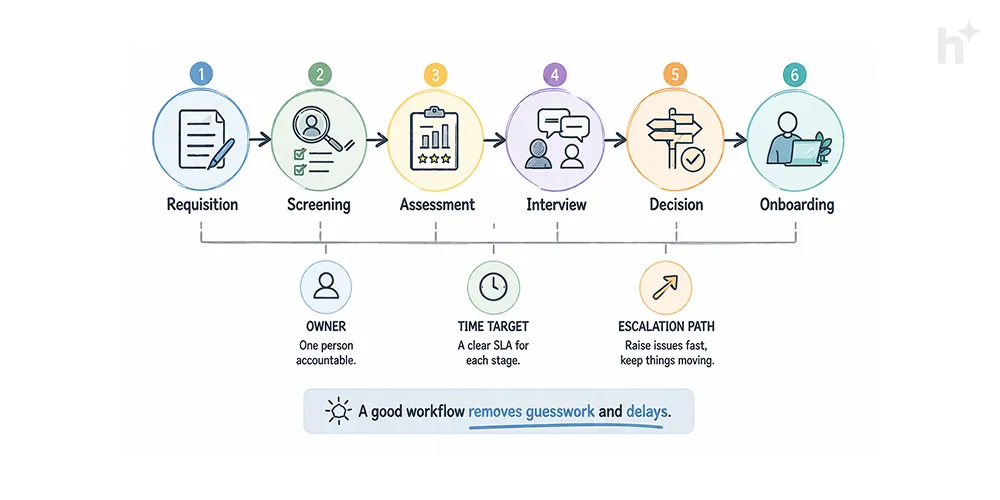
The six-stage hiring workflow (Requisition, Screening, Assessment, Interview, Decision, Onboarding Handoff) requires a defined owner, a capacity threshold, and a clear automation opportunity at each stage.
Candidates are 35% more likely to accept an offer when the recruitment process completes within two weeks (Glassdoor). Workflow speed is a competitive advantage.
A scalable hiring workflow is an end-to-end hiring process designed with defined stages, clear ownership, automated handoffs, and capacity thresholds so that increasing hiring volume doesn’t degrade speed, quality, or candidate experience.
The word “scalable” is specific. It doesn’t mean “busy” or “high volume.” It means the process can handle more volume without breaking. A workflow that requires one recruiter per 15 open requisitions and collapses at 20 isn’t scalable. A workflow where the system adapts when volume increases (through automation, workflow adjustments, or modular capacity additions) is scalable.
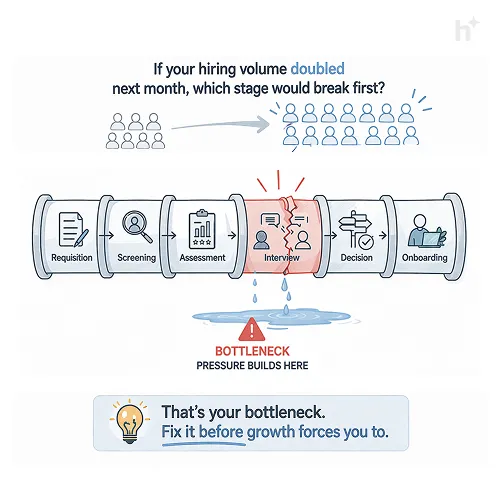
Most hiring workflows were built for a specific team size and hiring volume. They develop cracks when volume increases: scheduling delays, screening backlogs, communication gaps, and decision bottlenecks.
An end-to-end workflow covers every step from the moment a role is approved to the moment the new hire starts onboarding. Each step has a defined owner, a target completion time, a trigger for the next step, and a clear escalation path when things stall.
💡 Pro Tip: Test your workflow’s scalability with a simple thought experiment: if your hiring volume doubled next month, which stage would break first? That’s your bottleneck. Fix it before the volume increase forces you to.
Without a scalable workflow, every increase in hiring volume produces a proportional increase in time-to-hire, cost-per-hire, and candidate drop-off. Growth becomes self-limiting.
Unfilled roles cost approximately $500 per day in lost productivity (Deloitte). If your average time-to-fill is 43 days and a scalable workflow could reduce it to 25 days, that’s 18 fewer vacancy days per role. At $500/day, you recover $9,000 per hire. Across 100 hires per year, that’s $900,000.
60% of application abandonment stems from complexity, poor mobile experience, and communication gaps. These are workflow problems, not technology problems.
Candidates who complete a recruitment process within two weeks are 35% more likely to accept an offer (Glassdoor). The company with the faster workflow captures the candidate while competitors are still scheduling second-round interviews.
📊 Key Stat: 27% of talent acquisition leaders report unmanageable workloads, up from 20% the previous year. 45% say more touchpoints are required in the hiring process than before (SHRM). Without workflow scalability, recruiter capacity becomes the binding constraint on growth.
The primary benefit is predictability. A scalable workflow turns hiring from a reactive scramble into a repeatable process with consistent timelines, predictable costs, and reliable quality.
Consistent speed at any volume. Automated screening, templated assessments, and integrated scheduling eliminate the manual steps that slow down proportionally with volume.
Lower candidate drop-off. Each gap in your workflow is a point where candidates disengage. Connected workflows with automated status updates, instant scheduling, and clear next-step communication reduce drop-off by 30-40%.
Predictable cost-per-hire. A standardized workflow produces consistent costs that finance teams can actually forecast.
Recruiter capacity increase. When administrative tasks are automated, each recruiter can handle more open requisitions. Organizations with automated workflows report 25-40% higher recruiter capacity.
Better hiring manager experience. Hiring managers want qualified candidates quickly and minimal process overhead. A scalable workflow delivers both.
| Factor | Fragmented Workflow | Scalable Integrated Workflow | Time-to-hire consistency | Varies 30-90 days | Consistent 20-35 days |
|---|---|---|---|---|---|
| Recruiter capacity | 15-18 reqs per recruiter | 25-35 reqs per recruiter | Candidate drop-off rate | 40-60% | 15-25% |
| Cost-per-hire predictability | High variance (±50%) | Low variance (±15%) | Scaling approach | Add headcount proportionally | Increase volume on existing system |
A scalable hiring workflow operates in six connected stages: Requisition and Sourcing, Application and Screening, Assessment, Interview, Decision and Offer, and Onboarding Handoff. Each stage has a defined owner, time target, and automated trigger for the next stage.
Input: Business need, approved headcount, hiring manager request.
Process: Hiring manager submits a requisition through a standardized intake form. Recruiter conducts a 30-minute intake meeting to calibrate expectations. Job descriptions are published to relevant channels within 24 hours.
Output: Approved, published job with clear candidate profile, sourcing channels activated, and target timeline agreed.
Input: Incoming applications from all sourcing channels, plus pipeline candidates.
Process: AI-powered screening evaluates applications against defined criteria. Candidates meeting must-have requirements are automatically advanced. Disqualified candidates receive automated rejection within 48 hours. Recruiters conduct brief phone screens (15-20 minutes) for the qualified pool.
Output: Shortlist of 5-8 candidates ready for assessment, delivered within 5-7 business days of posting.
Input: Shortlisted candidates plus role-specific assessment criteria.
Process: Candidates complete standardized assessments (skills tests, work samples, case studies) scored against consistent rubrics. Results are automatically compiled and attached to profiles.
Output: Assessment scores and candidate profiles ready for interview panel review.
💡 Pro Tip: Standardize 3-5 assessment templates across your most common role types. This eliminates the “what should we test for?” conversation that adds 3-5 days to every process.
Input: Assessed candidates, interviewer availability, structured interview guides.
Process: Scheduling is automated based on interviewer calendars. Structured guides ensure every interviewer evaluates the same competencies. Post-interview scorecards submitted within 24 hours.
Output: Completed scorecards for all candidates, compiled for decision meeting.
Input: Scorecards, assessment results, hiring manager recommendation.
Process: Structured debrief meeting (30 minutes max). Decision based on scorecard data. Offer generated within 24 hours using pre-approved compensation parameters. Offer extended with clear response deadline.
Output: Extended offer with 48-72 hour response window.
Input: Accepted offer and new hire information.
Process: Upon acceptance, candidate transitions to onboarding. Structured handoff ensures onboarding team receives all relevant information. Pre-boarding communication begins immediately.
Output: New hire fully transitioned with zero information gaps.
| Stage | Owner | Time Target | Capacity Threshold | Automation Opportunity |
|---|---|---|---|---|
| Application & Screening | Recruiter + AI | 5-7 days | Breaks at 200+ apps per role | AI screening, auto-rejection |
| Interview | Coordinator | 5-7 days | Breaks at 15+ interviews/week | Automated scheduling, calendar sync |
| Onboarding Handoff | Recruiter + HR | 1-2 days | Breaks at 10+ new hires/month | Automated handoff, pre-boarding |
The single most impactful practice is automating interview scheduling. Scheduling consumes 35% of recruiter time and is the most common bottleneck extending time-to-hire (GoodTime, 2025 Hiring Insights Report).
Automate scheduling before anything else. Before: Recruiters spend 35% of time coordinating calendars. Time between “ready to interview” and “interview happens” averages 7-10 days. After: Automated scheduling syncs calendars, offers self-service booking, handles reschedules. Time drops to 2-3 days. Result: Recruiters recover 10+ hours per week.
⚠️ Watch Out: The most common failure is automating the wrong things first. Teams automate job posting distribution (saves minutes) while ignoring scheduling automation (saves hours). Prioritize by time impact.
Standardize intake meetings to 30 minutes with a template. Before: Intake meetings last 45-60 minutes, cover different ground, often need follow-ups. After: 30-minute template covers requirements, must-have vs preferred, interview panel, and timeline. Result: Faster start, consistent information captured.
Set maximum stage durations with automatic escalation. Before: Candidates sit for 2+ weeks because hiring managers haven’t provided feedback. After: Each stage has a max duration (48 hours for scorecards, 72 hours for decision scheduling). Automatic escalation if exceeded. Result: Stage stalls decrease by 60-70%.
Build role-type workflow templates. Before: Every requisition follows a slightly different process. After: 4-5 templates for common role types (engineering, sales, operations, leadership, high-volume). Result: Consistent candidate experience, faster setup.
Measure stage-to-stage conversion rates monthly. Before: Team tracks time-to-hire as single number. After: Monthly review of conversion rates and time at each stage. Result: Data-driven bottleneck identification.
| Condition | Recommended Action | Expected Outcome |
|---|---|---|
| Hiring manager feedback delays | Set 48-hour max with auto-escalation | 60-70% fewer stage stalls |
| Can’t identify workflow bottlenecks | Track stage-to-stage conversion monthly | Data-driven bottleneck identification |
The most common challenge is hiring manager disengagement: managers who are slow to provide feedback, reschedule interviews, or make decisions.
Recruiters build momentum, but hiring managers take 5-7 days to review resumes, another week to schedule interviews, another week for feedback. The candidate experiences 3 weeks of silence and withdraws.
Solution: Make responsiveness visible with a “hiring manager response time” dashboard. Share with leadership. Give managers mobile-friendly review tools and structured scorecard templates.
The process designed for standard roles falls apart for executive hires, high-volume hourly roles, or specialized technical positions.
Solution: Build role-type workflow variants. High-volume: condensed 3-stage process. Executive: extended 7-stage process. Technical: assessment-heavy process. Same architectural principles, adapted stage composition.
Candidate information splits between ATS, email threads, spreadsheet trackers, and calendar notes.
Solution: Consolidate on a single system of record (your ATS). Require API integration for auxiliary tools. Eliminate spreadsheet trackers.
The team fixes a bottleneck, then six months later old behavior returns.
Solution: Document standards in a playbook reviewed quarterly. Assign a process owner who monitors metrics, enforces standards, and proposes improvements. Treat the workflow like a product with a roadmap and regular release cycles.
Organizations that redesign their hiring workflow around scalability principles consistently reduce time-to-hire by 30-50% and increase recruiter capacity by 25-40% within two quarters.
Enterprise software company, 600 hires per year. Industry: Technology. Problem: Average time-to-hire reached 62 days. Scheduling consumed 40% of coordinator time. Hiring managers averaged 8 days to submit feedback. 23% of candidates withdrew. Intervention: Automated scheduling, 48-hour feedback deadlines with escalation, structured debrief meetings. Four role-type templates. Measured Outcome: Time-to-hire dropped from 62 to 29 days. Withdrawal rate decreased from 23% to 9%. Recruiter capacity increased from 16 to 27 requisitions per recruiter.
💡 Pro Tip: The software company’s biggest single improvement came from the 48-hour feedback deadline. Simply making response expectations explicit and visible reduced average feedback cycle from 8 days to 1.5 days.
Healthcare network, 1,500 hires per year. Industry: Healthcare. Problem: Clinical and non-clinical roles followed identical workflows despite vastly different requirements. The universal workflow added 15 unnecessary days to non-clinical hires. Intervention: Separate templates for clinical (7-stage with credential verification) and non-clinical (4-stage simplified). Automated credential verification. Measured Outcome: Non-clinical time-to-hire dropped from 48 to 22 days. Clinical time-to-hire decreased from 65 to 38 days. Zero credential verification errors after automation.
Fast-growing fintech startup, scaling from 80 to 300 employees. Industry: Financial Technology. Problem: Two-person team’s workflow was entirely manual. System worked at 5 hires/month but couldn’t handle 15/month pace for growth. Intervention: ATS with integrated scheduling, standardized intake templates, automated candidate communication. Three workflow templates. Measured Outcome: Scaled from 5 to 18 hires/month without adding headcount. Time-to-hire remained stable at 24 days despite 3.6x volume increase.
Retail chain, 2,000+ hourly hires per year. Industry: Retail. Problem: Hourly hiring used the same multi-stage process as salaried roles. Entry-level candidates went through resume screening, phone screen, in-person interview, and reference checks. Process took 28 days for roles where candidates expected to start within a week. Intervention: Dedicated high-volume workflow: automated screening quiz, same-day group interview, conditional offer within 24 hours. Removed reference checks for entry-level. Measured Outcome: Time-to-hire dropped from 28 to 4 days. First-week no-show rate decreased by 45%.
The single most important workflow metric is stage-to-stage velocity: how many days candidates spend in each stage.
Stage-to-stage velocity. Definition: Average time candidates spend in each stage. Calculation: Average (next stage entry date minus current stage entry date). Target Benchmark: Under 5 days per stage. Any stage exceeding 7 days is a bottleneck.
End-to-end time-to-hire. Definition: Total days from requisition to offer acceptance. Calculation: Offer acceptance date minus req approval date. Target Benchmark: Under 30 days standard, under 20 for high-volume.
Stage conversion rates. Definition: Percentage advancing from each stage. Calculation: (Entering next stage / Entering current stage) × 100. Target Benchmarks: Application to Screen: 20-30%. Screen to Interview: 50-60%. Interview to Offer: 25-35%. Offer to Hire: 85-95%.
Candidate drop-off rate. Definition: Percentage withdrawing at each stage. Calculation: (Withdrawn / Entering stage) × 100. Target Benchmark: Under 10% per stage.
Recruiter capacity utilization. Definition: Active requisitions per recruiter. Calculation: Active reqs / Recruiter count. Target Benchmark: 25-35 for full-cycle recruiters.
Hiring manager satisfaction score. Definition: HM rating of process quality. Calculation: Average post-hire survey rating (1-5). Target Benchmark: 4.0+ out of 5.0.
| Metric | What It Measures | How to Calculate | Target Benchmark |
|---|---|---|---|
| End-to-end time-to-hire | Total process duration | Offer accept minus req approval | Under 30 days |
| Candidate drop-off rate | Process friction points | (Withdrawn / Entered) × 100 | Under 10%/stage |
| HM satisfaction score | Stakeholder experience | Post-hire survey average | 4.0+ out of 5.0 |
The highest-severity risk is over-standardizing the workflow to the point where it can’t accommodate legitimate exceptions. Rigid workflows force square-peg candidates through round-hole processes.
⚠️ Watch Out: 60% of companies saw time-to-hire increase in 2025 despite technology investments (GoodTime, 2025 Hiring Insights Report). The pattern: teams buy automation tools but layer them onto broken workflows. Automating a bad process just produces bad results faster.
Automation without workflow redesign. Adding scheduling automation to a process with unnecessary interview rounds doesn’t solve the problem. Review whether each step needs to exist before automating it.
Template rigidity that can’t handle exceptions. Build flexibility through optional stages that can be activated or skipped based on role type.
Invisible bottlenecks in handoff points. Delays hide between stages: time between “screening complete” and “interview scheduled.” These handoff delays account for 40-60% of total time-to-hire but are invisible in stage-level metrics.
Candidate communication gaps between stages. When candidates don’t know where they stand, they assume the worst. Every stage transition should trigger an automated status update.
The most significant near-term trend is AI-driven workflow orchestration, where the system automatically adjusts stage sequences, timing, and resource allocation based on real-time hiring data.
Adaptive workflow routing. AI systems will dynamically route candidates through the optimal sequence of stages based on profile, role requirements, and team capacity.
Real-time bottleneck detection. AI monitoring will flag bottlenecks as they develop, automatically escalating stalled decisions and redistributing interviewer workload.
Integrated hiring and workforce planning. Workflows will connect directly to workforce planning systems, automatically triggering requisition creation based on attrition predictions and growth forecasts.
Candidate-controlled process navigation. Candidates will have more control: choosing interview times, selecting assessment formats, and accessing real-time status dashboards.
Most effective workflows have 5-7 stages for standard roles. Fewer than 5 usually means skipping important evaluation steps. More than 7 adds friction without improving decision quality. High-volume hourly roles can work with 3 stages. Executive hires may require 7-8.
Interview scheduling and hiring manager feedback delays. 35% of recruiter time goes to scheduling, and feedback averages 5-8 days. Automated scheduling and feedback deadlines with escalation are the two highest-impact fixes.
Automate administrative tasks (scheduling, status communication, screening), standardize with templates, and implement self-service tools for hiring managers. These typically increase recruiter capacity by 25-40%. SHRM’s workforce management benchmarks provide useful targets for recruiter-to-requisition ratios by company size.
No. Build 3-5 role-type templates: high-volume (3 stages), standard (5-6), technical (assessment-heavy), leadership (extended), and internal transfer (abbreviated).
Make it easy with mobile-friendly tools. Show personal metrics alongside team averages. Position the workflow as something that gets them better candidates faster, not administrative overhead from HR.
Interview scheduling. It consumes the most recruiter time, causes the most candidate-facing delays, and has the most mature automation solutions available.
A scalable hiring workflow isn’t a luxury for large companies. It’s the foundation that determines whether your hiring speed keeps pace with business growth. The organizations that reduced time-to-hire in 2025 (that 12% minority) did it by fixing workflow design, not by adding technology on top of broken processes.
The architecture is clear: six stages, each with an owner, a time target, a capacity threshold, and automation at every handoff. The biggest gains come from fixing the biggest bottlenecks first: scheduling automation, feedback deadlines, and standardized intake processes.
Start by measuring stage-to-stage velocity. Find the stage where candidates wait longest. Fix that stage. Then move to the next one. Explore hiremore AI to see how integrated workflow design connects every stage of hiring into a single, scalable system.
Ready to hire smarter?
Build structured pipelines, screen candidates with AI, and keep your team aligned from first application to final offer.
