


An AI-powered ATS that simplifies shortlisting, tagging, and workflows - built for fast, scalable, and collaborative hiring.
Landing Pages
Copyright © 2026|hiremore AI
An AI-powered ATS that simplifies shortlisting, tagging, and workflows - built for fast, scalable, and collaborative hiring.





The average recruiter spends about 6 seconds scanning a resume. At that speed, a hiring team reviewing 250 applications per role is making thousands of micro-judgments based on formatting, keywords, and pattern recognition — rather than genuine qualification assessment. AI resume screening replaces that 6-second scan with a structured, criteria-driven evaluation that processes every resume against the same standards, whether it’s application #1 or application #500.
But here’s what most guides won’t tell you: AI resume screening isn’t magic, and it’s not automatic. A poorly configured AI screening system will reject great candidates and advance weak ones just as confidently as a well-configured one advances the right people. The difference is entirely in the setup.
This guide covers how AI resume screening actually works under the hood, where it consistently fails, and the specific configuration steps that separate reliable screening from expensive guesswork. It’s written for recruiters, talent acquisition leaders, and HR professionals who want to move beyond vendor marketing claims and understand what it takes to get AI screening right.
Before diving in: AI Resume Parsing: What It Can and Cannot Do explains precisely how AI extracts structured data from resume text — and where it breaks down — giving you the foundation to configure screening correctly.
AI resume screening uses natural language processing and machine learning to parse, score, and rank resumes against job-specific criteria, reducing screening time from hours to minutes.
AI maintains 85-95% evaluation consistency compared to 60-70% inter-rater reliability among human reviewers, which means the same candidate gets the same assessment regardless of when their resume is reviewed.
The #1 configuration mistake is relying on keyword matching alone. Modern AI screening tools evaluate context, skills adjacency, and experience patterns, but only when criteria are defined with enough specificity.
82% of companies now use AI for resume reviews, but 67% acknowledge their tools could introduce bias. Quarterly bias audits with demographic pass-through analysis are the minimum responsible standard.
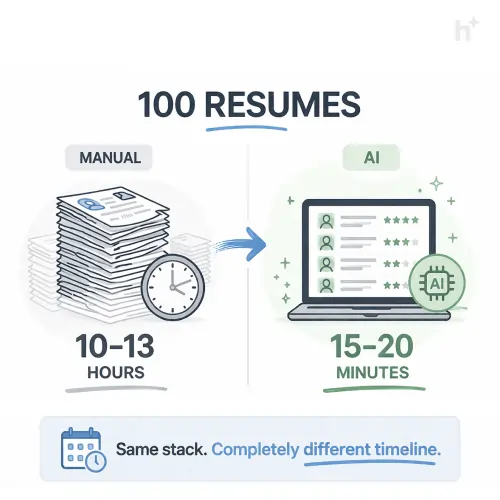
AI screening processes 100 resumes in 15-20 minutes versus 10-13 hours of manual review. For a team screening 500 applications per role, that’s the difference between a morning task and a full work week.
The best AI screening implementations reduce cost-per-screen by up to 70% and increase the proportion of relevant candidates reaching interview stage by 20%.
AI resume screening is the automated process of parsing, analyzing, and scoring resumes against job-specific criteria using natural language processing (NLP) and machine learning, producing a ranked shortlist of qualified candidates without manual review of every application.
It’s important to distinguish AI resume screening from basic ATS keyword filtering. An Applicant Tracking System (ATS) is primarily a workflow tool. It organizes applications, tracks candidates through pipeline stages, and manages recruiter tasks. AI resume screening is the intelligence layer that sits on top of (or integrates with) the ATS to make candidate evaluation decisions.
Basic keyword filters look for exact matches. If the job description says “project management” and the resume says “managed cross-functional initiatives,” a keyword filter might miss the match entirely. AI screening tools use NLP to understand context. They recognize that “managed cross-functional initiatives” demonstrates project management capability even without the exact phrase.
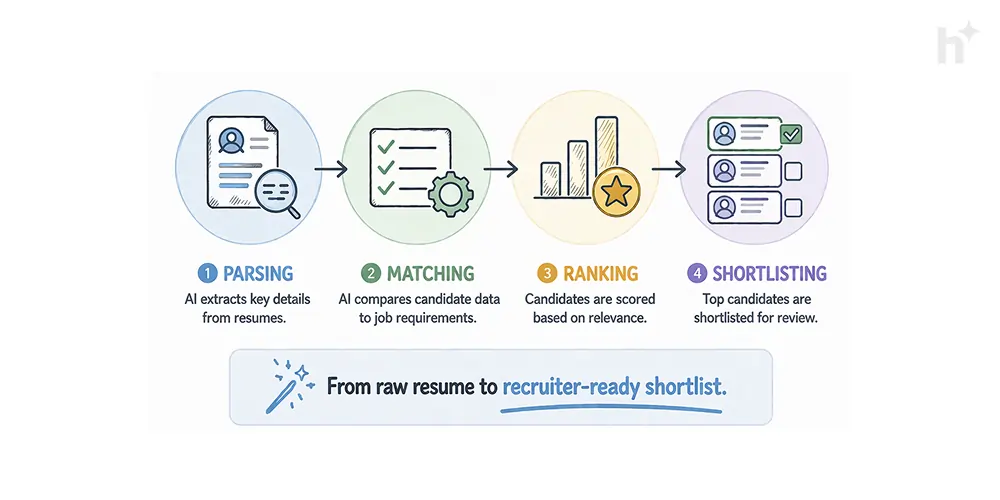
The technology operates in three layers. First, parsing: the system extracts structured data from unstructured resume text, identifying names, contact information, work history, education, skills, and certifications. Second, matching: the parsed data is evaluated against job-specific criteria with weighted scoring. Third, ranking: candidates receive composite scores and are ordered from strongest to weakest match, with those above a configurable threshold flagged for human review.
Understanding what AI can and can’t reliably extract from resumes is worth examining on its own — AI Resume Parsing: What It Can and Cannot Do breaks down exactly where the technology succeeds and where it still falls short.
📊 Key Stat: AI screening tools process 100 resumes in 15–20 minutes. The same task takes a human reviewer 10–13 hours. At 500 applications per role, AI screening compresses a week of manual work into a single morning.
Manual screening can’t keep pace with modern application volumes. AI resume screening solves the speed problem while improving consistency, but the real value is in catching qualified candidates that human reviewers miss during quick scans.
The volume problem is well documented. The average corporate job posting attracts 250 applications. High-profile roles or remote positions can pull 1,000 or more. A recruiter spending the industry-standard 6 seconds per resume isn’t reading. They’re pattern matching: scanning for familiar company names, expected job titles, and obvious keywords. Qualified candidates with non-traditional backgrounds, career transitions, or unusual resume formats get filtered out before a human even reads their first bullet point.
This isn’t a theoretical concern. Research from the World Economic Forum found that traditional resume screening groups had a 28.57% success rate at subsequent human interviews, while candidates screened through AI-led processes succeeded at 53.12%. The AI wasn’t smarter. It was more thorough. It read every section of every resume against the full criteria set, something no human reviewer does under time pressure.
AI adoption in hiring has been rising sharply. According to SHRM, AI adoption in HR tasks climbed from 26% to 43% between 2024 and 2025 — a 65% increase in just one year — with resume screening driving much of that growth.
The cost impact compounds at scale. A mid-sized company screening 500 resumes per role, with 20 open positions, faces 10,000 resumes per hiring cycle. At an average recruiter cost of $35/hour and 5 minutes per manual screen, that’s roughly $29,000 in screening labor alone. AI screening reduces that cost by 70% or more, while improving the quality of the shortlist that reaches interview stage.
⚠️ Watch Out: Speed alone isn’t the goal. A system that screens 500 resumes in 10 minutes but produces a poor shortlist is worse than slow manual screening. Always validate AI screening accuracy before expanding volume.
AI resume screening’s primary benefit is evaluation consistency. Every candidate is measured against identical criteria, eliminating the drift, fatigue, and unconscious shortcuts that degrade manual screening quality over time.
Consistency across every application. Human reviewers are inconsistent. The resume reviewed first thing Monday gets a different evaluation than the one reviewed at 4:30 PM on Friday. Studies show human inter-rater reliability in resume screening sits between 60–70%. Harvard Business Review research found that AI-supported assessment processes produced 24–30% higher consistency scores compared to unassisted human review. AI systems maintain 85–95% consistency, meaning a qualified candidate has the same chance of advancing whether they applied first or last.
Speed that changes the game. AI doesn’t just screen faster. It changes what’s possible. When screening takes hours, recruiters batch-process applications weekly. When screening takes minutes, recruiters review qualified shortlists daily. That speed advantage means your top candidates hear back in 24 hours instead of 10 days, which matters when they’re also applying to your competitors.
Deeper skills recognition. Modern AI screening goes beyond keyword matching. NLP-powered tools recognize skill synonyms, adjacent competencies, and experience patterns. A candidate who writes “built and led a distributed engineering team across three time zones” gets credit for remote team management, cross-functional leadership, and distributed systems experience, even if none of those exact phrases appear in the job description.
Reduced cost per screening decision. AI screening can reduce cost-per-screen from $3–5 per resume (manual) to under $1 per resume (automated). For organizations processing thousands of applications per quarter, this translates to tens of thousands in annual savings that can be redirected to candidate engagement and employer branding.
Scalability during hiring surges. The system that screens 200 resumes can screen 20,000 with no extra cost or quality degradation. For organizations with seasonal hiring spikes, acquisition-driven growth, or rapid scaling needs, AI screening eliminates the choice between speed and quality.
| Factor | Manual Screening | AI Resume Screening |
|---|---|---|
| Time per 100 resumes | 10-13 hours | 15-20 minutes |
| Evaluation consistency | 60-70% inter-rater reliability | 85-95% consistency |
| Cost per resume screened | $3-5 | Under $1 |
| Skills recognition | Exact keyword match only | Contextual NLP with synonyms |
| Scalability | Linear (more resumes = more hours) | Near-instant at any volume |
| Fatigue impact | Degrades after 50-100 resumes | None |
AI resume screening operates in four stages: parsing (extracting data), matching (scoring against criteria), ranking (ordering candidates), and shortlisting (flagging top candidates for human review).
Input: Raw resume files in various formats (PDF, DOCX, plain text, HTML from online applications).
Process: The AI system extracts structured data from unstructured resume text using Natural Language Processing (NLP). It identifies and categorizes: personal information, work history (company names, titles, dates, responsibilities), education (institutions, degrees, dates), skills (technical and soft), certifications, and any additional sections. Modern parsers handle multi-column layouts, non-standard formatting, and international resume conventions.
Output: A structured candidate profile with tagged data fields ready for criteria matching. Research shows current AI parsers achieve approximately 95% parsing accuracy on standard resume formats.
Input: Structured candidate profile plus the job’s evaluation criteria (must-have qualifications, preferred qualifications, weighted skill requirements).
Process: The AI evaluates each parsed data point against the job criteria. This isn’t simple keyword matching. Modern systems use semantic understanding to assess whether a candidate’s experience satisfies a requirement. For example, “5+ years leading engineering teams” can be matched against a work history showing “Engineering Manager, 2018-2024” with team-related responsibilities. Each criterion receives a match score based on relevance, depth, and recency of experience.
Output: A per-criterion score for each candidate, with clear indicators of which requirements are fully met, partially met, or unmet.
💡 Pro Tip: The quality of this stage depends entirely on how well you define your screening criteria. Vague criteria like “strong technical background” produce vague results. Specific criteria like “3+ years working with Python in a production environment” produce precise, reliable matches. See How to Build AI-Powered Resume Screening Criteria for a step-by-step framework for writing criteria that produce reliable shortlists.
Input: Per-criterion scores for all candidates, plus configured scoring weights (how much each criterion matters relative to others).
Process: The system calculates a composite score for each candidate based on weighted criteria scores. Must-have criteria typically carry knockout weight (candidates missing them are automatically excluded regardless of other scores). Preferred criteria carry graduated weights. The ranking algorithm orders all candidates from highest to lowest composite score.
Output: A ranked candidate list with composite scores, individual criterion breakdowns, and clear explanations of why each candidate scored as they did.
For a deeper look at how composite scores are calculated and what variables influence ranking, How AI Ranks Candidates: Understanding Scoring Algorithms covers the mechanics in full.
Input: Ranked candidate list plus configured shortlist thresholds (minimum score for advancement, maximum shortlist size, or both).
Process: Candidates above the threshold are flagged for human review. The system generates a shortlist with candidate summaries highlighting strengths, potential gaps, and match confidence levels. Critically, the AI provides its reasoning, not just its scores, so recruiters can evaluate whether the scoring logic makes sense for each specific candidate.
Output: A recruiter-ready shortlist with candidate profiles, match explanations, and recommended next steps. Candidates below the threshold are held (not rejected) pending recruiter confirmation.
Once shortlisted candidates advance, AI-powered interviews can continue the structured evaluation. The Complete Guide to AI-Powered Interviews outlines how to carry the same consistency from screening into the interview stage.
| Stage | Input | Process | Output |
|---|---|---|---|
| Parsing | Raw resume files | NLP data extraction | Structured candidate profile |
| Matching | Profile + job criteria | Semantic criteria evaluation | Per-criterion match scores |
| Ranking | Match scores + weights | Weighted composite scoring | Ordered candidate list |
| Shortlisting | Ranked list + thresholds | Threshold-based filtering | Recruiter-ready shortlist |
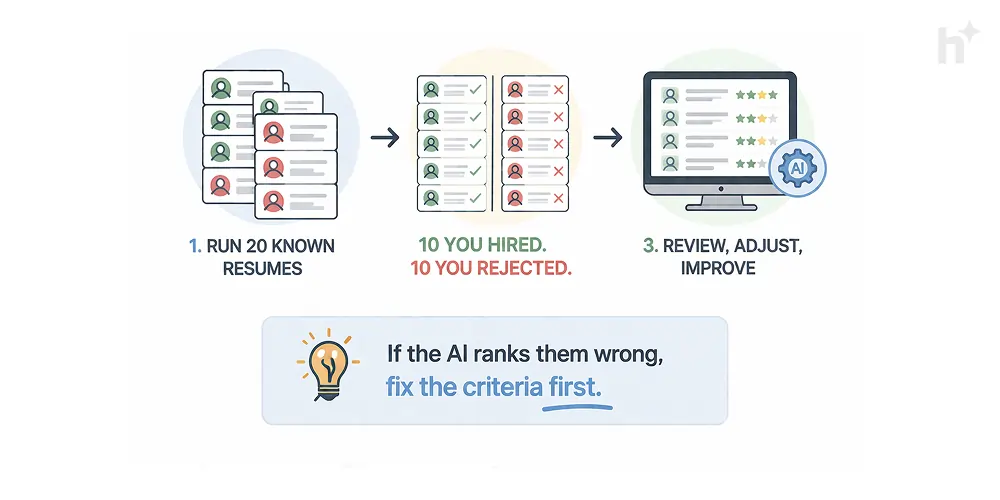
The single most impactful practice is calibrating your screening criteria with test resumes before processing real candidates. Feed the system 10 known-good and 10 known-poor resumes and verify it ranks them correctly.
Separate must-have criteria from nice-to-have criteria. Before: All criteria are weighted equally, so a candidate with a preferred certification but missing a required skill scores as well as someone with the required skill but no certification. After: Must-have criteria act as knockout filters, and nice-to-have criteria influence ranking within the qualified pool. Result: Shortlists contain only candidates who meet baseline requirements, ranked by additional differentiators.
Calibrate with known candidates before going live. Before: AI screening goes live on real applications without validation, and recruiters discover scoring problems after qualified candidates have already been passed over. After: Run 20-30 historical resumes (candidates you hired and candidates you rejected) through the system and compare AI rankings to actual outcomes. Result: Configuration errors are caught before they affect real candidates.
Write screening criteria as observable behaviors, not adjectives. Before: Criteria include “excellent communicator” and “strong leader,” which AI interprets inconsistently across different resume writing styles. After: Criteria specify “presented technical decisions to executive stakeholders” and “managed a team of 5+ direct reports.” Result: AI matching accuracy improves by 20-30% because the criteria are specific enough for reliable evaluation.
⚠️ Watch Out: Never rely on AI screening as the sole rejection mechanism for candidates. Always maintain a human review step for borderline candidates (those scoring within 10% of your threshold). The
four-fifths rulerequires that no demographic group’s pass rate falls below 80% of the highest-passing group’s rate.
Review and update criteria every quarter. Before: Screening criteria set during initial configuration remain unchanged for 12+ months, even as role requirements evolve. After: Quarterly reviews incorporate hiring manager feedback, post-hire performance data, and market changes. Result: Screening accuracy stays calibrated to current needs rather than drifting from outdated criteria.
Use AI screening output as a recommendation, not a decision. Before: Recruiters treat AI shortlists as final and only review candidates the system advanced. After: Recruiters review the shortlist plus a random sample of rejected candidates each cycle to validate accuracy. Result: Systematic quality assurance catches edge cases the AI misses and improves model performance over time.
| Condition | Recommended Action | Expected Outcome |
|---|---|---|
| High-volume roles (200+ applicants) | Full AI screening with must-have knockouts | 70%+ reduction in screening time |
| Niche technical roles (under 30 applicants) | AI-assisted ranking with full human review | Better prioritization without false rejections |
| Roles with diverse applicant backgrounds | Skills-based criteria without credential requirements | 25% increase in qualified diverse candidates |
| New roles with no historical hiring data | Conservative scoring with wider shortlists | Broader candidate pool while building baseline data |
The most common challenge is the “black box” problem: recruiters don’t understand why the AI scored candidates the way it did, which undermines trust and leads to workaround behaviors.
AI learns patterns from historical data. If your company historically hired from a narrow set of universities, industries, or demographic profiles, the AI will learn to prefer those patterns. This doesn’t just perpetuate existing bias. It scales it to every application.
Solution: Audit pass-through rates by demographic group quarterly. Remove identifying information (names, photos, addresses) from the data the AI evaluates. Use skills-based criteria rather than credential-based proxies. Research from the University of Washington (2025) found that human reviewers followed biased AI hiring recommendations approximately 90% of the time — meaning bias in the screening model doesn’t stay contained to that step, it cascades into every subsequent hiring decision. Bias prevention at the AI configuration level is therefore more critical than training reviewers to override it after the fact. For a structured approach to catching these patterns early, see How to Audit Your AI Screening for Fairness.
Creative resume formats, infographic resumes, multi-column layouts, and non-standard section headers can confuse even modern AI parsers. When parsing fails, qualified candidates get inaccurate scores.
Solution: Accept that parsing will never be 100% accurate on non-standard formats. Set your system to flag resumes with low parsing confidence for manual review rather than scoring them with incomplete data.
Even with NLP capabilities, some AI screening tools default to keyword-heavy matching when criteria aren’t defined with enough specificity. This penalizes candidates who describe their experience differently than the job description.
Solution: Define criteria using competency descriptions rather than job title keywords. Instead of screening for “Product Manager,” screen for “defined product roadmaps, prioritized feature backlogs, and collaborated with engineering teams on delivery timelines.”
Hiring managers who haven’t seen AI screening in action often doubt its quality, especially when a shortlisted candidate doesn’t “look right” based on their mental model of the ideal hire.
Solution: Provide match explanations alongside candidate profiles. Show hiring managers exactly which criteria each candidate met, at what score, and why. Transparency converts skepticism into informed evaluation. Run parallel comparisons for the first 2-3 hiring cycles.
Organizations implementing properly configured AI resume screening consistently report 60-80% reduction in screening time and 15-25% improvement in interview-to-offer ratios within the first two hiring cycles.
Enterprise technology company, 300+ engineering hires per year. Industry: Technology. Problem: Each engineering role attracted 400-600 applications, and the three-person recruiting team spent 60+ hours per role on initial screening alone. By the time interviews were scheduled, top candidates had already accepted competing offers. Intervention: Deployed AI resume screening with skills-based criteria (specific programming languages, system design experience, team leadership indicators) and an automated shortlisting threshold. Measured Outcome: Screening time dropped from 60 hours to 8 hours per role. Time from application to first interview shortened from 45 days to 10 days. Offer acceptance rate increased by 18% because candidates heard back faster.
💡 Pro Tip: The biggest ROI from AI resume screening often isn’t the screening speed itself. It’s the downstream impact on offer acceptance rates. Candidates who receive faster responses are significantly more likely to stay engaged with your process.
Healthcare system, 1,200 clinical and non-clinical hires per year. Industry: Healthcare. Problem: Credentialing requirements for clinical roles meant screening involved verifying licenses, certifications, and continuing education units alongside standard qualifications. Manual verification was error-prone and slow. Intervention: Implemented AI screening with credential extraction and verification workflows integrated into the parsing stage. Created separate screening profiles for clinical (credential-heavy) and non-clinical (experience-heavy) roles. Measured Outcome: Credential verification accuracy improved from 78% to 96%. Screening time for clinical roles dropped by 65%. Compliance team reported zero credentialing errors in the first year.
Financial services firm, 500 annual hires across compliance-heavy roles. Industry: Financial Services. Problem: Regulatory requirements meant screening had to verify specific certifications (Series 7, CFA, CPA) and compliance training histories. Manual review was thorough but slow, averaging 12 minutes per resume. Intervention: Configured AI screening with mandatory credential matching as knockout criteria and experience-based scoring for ranking. Added automated regulatory compliance flagging. Measured Outcome: Screening speed improved by 75%. False-positive rate on credential matching dropped from 8% to under 2%. Compliance documentation became automatically generated.
Staffing agency, 5,000+ placements per year across 40+ clients. Industry: Staffing. Problem: Multiple clients with different screening criteria meant recruiters constantly context-switched between role types, leading to inconsistent screening quality and frequent client complaints about shortlist relevance. Intervention: Created client-specific AI screening profiles with customized criteria, scoring weights, and shortlist thresholds. Measured Outcome: Client satisfaction scores increased by 32%. Shortlist rejection rates dropped from 35% to 12%. Recruiter capacity increased from 12 to 22 active client accounts per recruiter.
The single most important metric for AI resume screening is screening-to-interview conversion rate: the percentage of AI-shortlisted candidates who advance past the first human interview.
Screening-to-interview conversion rate. Definition: The percentage of AI-shortlisted candidates who pass the first human review or phone screen. Calculation: (Candidates approved after human review / Total AI-shortlisted candidates) × 100. Target Benchmark: 75-85%. Below 70% indicates AI criteria are too loose. Above 90% may indicate criteria are too restrictive.
Time-to-shortlist. Definition: Hours or days from application receipt to recruiter-approved shortlist delivery. Calculation: Timestamp of shortlist delivery minus timestamp of application deadline or posting date. Target Benchmark: Under 48 hours for standard roles, under 24 hours for high-volume roles.
False negative rate. Definition: Percentage of qualified candidates the AI incorrectly screened out, measured by sampling rejected candidates. Calculation: (Qualified candidates found in rejection sample / Total rejection sample) × 100, extrapolated to full rejection pool. Target Benchmark: Under 5%. Measured by having recruiters review a random 10% sample of rejected candidates monthly.
Cost-per-screen. Definition: Total screening cost (tool licensing + recruiter time for shortlist review) divided by number of resumes screened. Calculation: (AI tool cost + recruiter review hours × hourly rate) / Total resumes processed. Target Benchmark: Under $1.50 per resume, compared to $3-5 for fully manual screening.
Demographic pass-through rate. Definition: The rate at which candidates from different demographic groups pass through AI screening, measured to detect bias. Calculation: (Candidates advanced from group / Total candidates from group) × 100, compared across groups. Target Benchmark: No group’s pass rate should fall below 80% of the highest-passing group’s rate (the four-fifths rule).
Parsing accuracy rate. Definition: Percentage of resumes where the AI correctly extracted and categorized all major data fields. Calculation: (Resumes with accurate parsing / Total resumes parsed) × 100. Target Benchmark: 90%+ on standard formats. Flag non-standard formats for manual review.
| Metric | What It Measures | How to Calculate | Target Benchmark |
|---|---|---|---|
| Screening-to-interview conversion | Shortlist quality | (Approved / Shortlisted) × 100 | 75-85% |
| Time-to-shortlist | Screening speed | Shortlist delivery minus posting date | Under 48 hours |
| False negative rate | Missed qualified candidates | Sample-based review of rejections | Under 5% |
| Cost-per-screen | Cost efficiency | (Tool + review cost) / Resumes processed | Under $1.50 |
| Demographic pass-through rate | Bias detection | Group pass rates compared across groups | Four-fifths rule compliance |
| Parsing accuracy rate | Data extraction quality | (Accurate parses / Total) × 100 | 90%+ |
The highest-severity risk is deploying AI screening without bias audits. At scale, a biased screening algorithm doesn’t just affect individual candidates. It creates patterns of systematic exclusion that trigger legal liability and damage employer reputation.
⚠️ Watch Out: A University of Washington study found that human reviewers followed biased AI recommendations approximately 90% of the time. This means bias in the AI doesn’t stay contained to the automated screening step. It cascades through every subsequent hiring decision. Fixing bias at the AI level is more critical than training human reviewers to override it.
Proxy discrimination through non-obvious criteria. AI screening can learn to use seemingly neutral criteria as proxies for protected characteristics. Zip codes correlate with race. Graduation years correlate with age. Specific university names correlate with socioeconomic background. Even when identifying information is removed, these proxy signals can perpetuate discriminatory patterns.
Over-rejection of non-traditional candidates. Career changers, self-taught professionals, candidates with employment gaps, and those from non-standard educational backgrounds consistently score lower in AI screening systems configured around traditional career progression patterns. This narrows your talent pool and hurts diversity.
Regulatory non-compliance. New York City’s Local Law 144 requires annual bias audits for automated employment decision tools. The EU AI Act classifies hiring AI as high-risk, requiring conformity assessments and documented human oversight as part of its compliance framework — with obligations phasing in through 2026 and beyond. Illinois, Maryland, and other jurisdictions have additional requirements.
Candidate perception damage. 66% of U.S. adults say they’d avoid applying to companies that use AI in hiring decisions. Without transparent communication about how AI is used and what role human judgment plays, AI screening can actively shrink your applicant pool, particularly among experienced candidates who have the options to be selective about where they apply.
Configuration drift over time. Screening criteria set during initial configuration become less accurate as roles evolve, market conditions shift, and hiring standards change. Without quarterly recalibration, AI screening systems produce increasingly unreliable results while appearing to function normally.
The most significant near-term trend is the shift from keyword-and-credential matching to skills-based screening powered by large language models that evaluate what candidates can actually do, not just what’s listed on their resume.
LLM-powered contextual screening. The clearest trend in 2025-2026 is the migration from pattern-matching models to large language model-based tools that read and interpret resume content contextually. These systems can evaluate career narratives, assess skill depth from project descriptions, and identify transferable competencies that traditional models miss.
Skills-based screening replacing credential filtering. A growing movement advocates replacing degree requirements and credential-based filtering with verified skills assessment. AI screening tools are beginning to infer skill levels from project descriptions, work output references, and portfolio links rather than relying on institutional credentials.
Multimodal candidate assessment. AI screening is expanding beyond resume text to incorporate data from skills assessments, screening questionnaires, and even video introduction analysis. The resume becomes one data source among several, reducing the impact of resume-writing ability on screening outcomes.
Explainable AI for compliance. As regulatory requirements increase, AI screening vendors are investing in explainable AI features that show recruiters exactly why a candidate scored the way they did. This transparency isn’t just a compliance requirement. It’s a trust-building tool for candidates and hiring managers.
Continuous learning from hiring outcomes. Next-generation AI screening systems will close the feedback loop by tracking which screened candidates succeed post-hire and automatically adjusting screening criteria based on actual performance data.
ATS keyword filtering looks for exact word matches between the job description and the resume. If the job says “project management” and the resume says “led cross-functional delivery teams,” a basic ATS misses the match. AI resume screening uses natural language processing to understand meaning, not just words. It recognizes synonyms, related concepts, and contextual indicators of competency. The AI evaluates whether a candidate possesses a skill, not whether they used a specific phrase.
Modern AI parsers handle most standard and semi-standard formats with 90%+ accuracy. Highly creative formats (infographic resumes, video resumes, portfolio-style layouts) still cause parsing errors. The best approach is configuring your system to flag low-confidence parses for manual review rather than scoring them with incomplete data.
It can, depending on how criteria are configured. If screening criteria emphasize specific degree types, linear career progression, or experience at well-known companies, candidates with non-traditional backgrounds will score lower regardless of their actual capabilities. The solution is skills-based criteria that evaluate competencies rather than credentials.
AI screening maintains 85-95% evaluation consistency, compared to 60-70% inter-rater reliability for human reviewers. Accuracy depends on criteria quality. With well-defined, specific criteria, AI screening identifies qualified candidates at rates equal to or better than human review. With vague criteria, AI screening produces unreliable results.
AI screening shows clear ROI at 50+ applications per role. Below that threshold, the time saved on screening may not justify the setup and configuration effort. However, even for low-volume roles, AI screening adds value through consistency. For organizations hiring across multiple roles simultaneously, the cumulative time savings make AI screening worthwhile even for individual roles with smaller applicant pools.
Audit by comparing pass-through rates across demographic groups on a quarterly basis. Apply the four-fifths rule: no group’s advancement rate should fall below 80% of the highest-advancing group’s rate. If disparities appear, examine screening criteria for proxy discrimination (zip codes, graduation years, institution names that correlate with protected characteristics). Remove or reweight those criteria and retest. Document every audit and its findings for regulatory compliance.
AI resume screening works when it’s configured as a structured evaluation system, not when it’s treated as a plug-and-play tool. The technology is mature enough to screen 500 resumes with more consistency than a human reviewer, process applications 30-40x faster, and identify qualified candidates that manual scanning would miss. But those outcomes depend entirely on how well you define your screening criteria, how frequently you audit for bias, and whether you maintain human oversight at the right decision points.
The tension in AI resume screening is straightforward: 82% of companies now use it, but 67% acknowledge bias risks. The path forward isn’t avoiding the technology. It’s implementing it with the configuration discipline and audit rigor that reliable screening demands. Start with well-defined criteria, calibrate with test resumes, audit quarterly, and treat AI output as a recommendation rather than a decision.
For teams ready to move past manual screening without sacrificing quality, explore the hiremore AI platform to see how structured AI resume screening works in practice.
Ready to hire smarter?
Build structured pipelines, screen candidates with AI, and keep your team aligned from first application to final offer.
