


An AI-powered ATS that simplifies shortlisting, tagging, and workflows - built for fast, scalable, and collaborative hiring.
Landing Pages
Copyright © 2026|hiremore AI
An AI-powered ATS that simplifies shortlisting, tagging, and workflows - built for fast, scalable, and collaborative hiring.





Most recruitment automation implementations start in the middle. A team adds an interview scheduling tool, or automates their rejection emails, without a clear view of which stages before and after still contain manual bottlenecks. The result is a partially automated process that’s faster in one place and still broken everywhere else.
End-to-end hiring automation means connecting the entire pipeline — from requisition approval to offer signed — with automation handling every rules-based task and humans retaining every decision point. Done in the right order, it compounds in value quickly. Done without a blueprint, it creates integration complexity without proportional return.
This is the blueprint: stage by stage, what to automate, in what order, and where to keep humans.
End-to-end hiring automation connects every rules-based task from req approval to offer signed — while preserving human judgment at every decision point.
Implementation sequence matters more than implementation completeness. Starting with scheduling and posting automation delivers ROI within weeks. Starting with AI screening without a functioning ATS underneath it wastes the investment.
The three highest-ROI first automations are job posting syndication, candidate communications, and interview scheduling. These return value immediately and create the data foundation for later stages.
A fully automated pipeline still has five human touchpoints: requisition approval, shortlist review, second-round interview, offer approval, and final decision. None of these should be removed.
Teams with full-funnel automation report 40–60% reductions in time-to-hire without adding recruiting headcount (Aptitude Research, 2024).
End-to-end hiring automation is the systematic use of software to handle every rules-based, non-judgment task across the full hiring pipeline — so recruiter time is concentrated entirely on decisions that require human expertise.
It doesn’t mean removing humans from hiring. It means removing humans from the tasks that don’t require them: posting jobs, sending acknowledgement emails, scheduling screens, collecting interview feedback, sending status updates, routing candidates between stages. Every one of those tasks follows a rule. Every one of them can be automated.
What’s left after automation is the work that genuinely benefits from human involvement: reviewing shortlists with context the algorithm doesn’t have, conducting second-round conversations, making offers, and negotiating terms. That work is better when the humans doing it aren’t simultaneously managing 200 administrative tasks.
Automation at later pipeline stages only delivers value if earlier stages are functioning correctly. AI screening without reliable application intake is noise. Interview scheduling automation without a functional shortlist is empty calendar slots.
The sequence follows the pipeline. Fix and automate early stages first — posting, intake, acknowledgement — before adding sophistication at screening and scheduling.
Teams that implement AI screening before their ATS data quality is reliable end up with AI-ranked shortlists built on incomplete or inconsistent application data. The technology looks like it’s failing. The data is the actual problem.
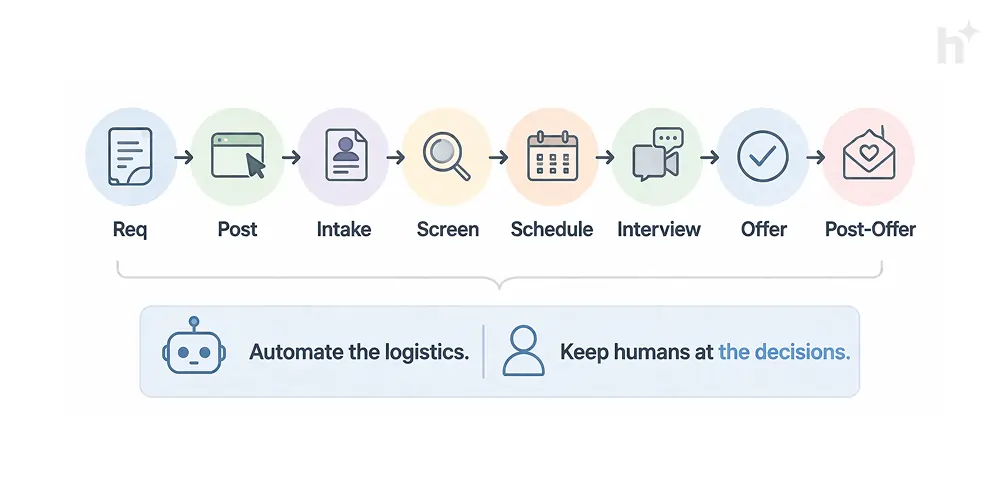
The eight-stage pipeline below maps what automation handles and what humans handle at each point, from requisition through to offer.
💡 Pro Tip: Set a manual review buffer of 10–15% around your shortlist cutoff. Candidates just inside and just outside the threshold deserve human review before automatic advancement or rejection.
| Stage | Primary Automation | Human Role |
|---|---|---|
| Req Approval | Routing and reminders | Approve req |
| Job Posting | Syndication and tracking | Approve description |
| Application Intake | Dedup, tagging, acknowledgement | None |
| First-Round Screen | AI interview, scoring, ranking | Review shortlist |
| Scheduling | Self-scheduling, reminders | Maintain availability |
| Second-Round | Pre-interview briefing, feedback collection | Conduct interview |
| Decision and Offer | Feedback consolidation, offer draft | Make decision, deliver offer |
| Post-Offer | Rejection comms, closure, onboarding trigger | Handle negotiation |
Implement in this order: posting and acknowledgement first (immediate time saving, low risk), then scheduling (high ROI, fast to configure), then AI screening (highest impact, requires data foundation), then offer and post-offer workflows.
Five points in the pipeline require human judgment and should never be fully automated: req approval, shortlist review, second-round interview, hiring decision, and offer negotiation.
These aren’t arbitrary exceptions. Each involves a judgment call that automation can inform but not replace:
⚠️ Watch Out: Any system configuration that allows candidates to be automatically rejected, advanced to offer, or moved between pipeline stages without a human confirmation step is a compliance and quality risk. Automation should route and recommend. Humans should confirm and decide.
The three most common mistakes are implementing out of sequence, automating without documenting the process first, and failing to build a human review step at shortlist stage.
Automating out of sequence. Adding AI screening before ATS data quality is reliable produces poor shortlists. Adding scheduling automation before a functional shortlist exists produces empty calendar slots. Follow the pipeline order.
Skipping process documentation. Automation implements whatever process logic you give it. If your current hiring process is undocumented and inconsistent, automated inconsistency is worse than manual inconsistency — it scales faster and is harder to diagnose.
Removing human review at shortlist stage. Teams that let AI screening automatically advance candidates to scheduling — without human review of the shortlist — are making hiring decisions by algorithm. That’s a quality risk and a legal risk. The shortlist should always require explicit human sign-off before candidates advance.
Full-funnel automation implementations produce the strongest ROI in companies running 15+ simultaneous open roles, where the cumulative bottlenecks across all stages are large enough to represent multiple FTE of recruiter time.
SaaS Growth Stage — 15 Roles, 2 Recruiters. A 200-person SaaS company with 15 open roles and a two-person recruiting team implemented the blueprint in sequence over 8 weeks. Week 1–2: posting and acknowledgement. Week 3–4: scheduling. Week 5–6: AI screening. Week 7–8: feedback automation. End result: average time-to-hire dropped from 34 days to 19 days. Recruiter capacity freed from administrative tasks was redirected to stakeholder prep and offer management. One of the two recruiters was redeployed to a strategic sourcing project that had been deprioritised for 6 months.
Logistics — Seasonal Surge, 300 Roles. A logistics operator used the blueprint to run a peak-season hiring campaign for 300 roles across 12 sites in 8 weeks. All stages from posting through first-round screening were automated. Human review happened at shortlist stage per site. Scheduling and feedback collection were fully automated. The campaign was run by a central team of 4 recruiters who would previously have required 10–12 for equivalent volume.
🏆 Best Result: The logistics case: 300 roles, 12 sites, 8 weeks, 4 recruiters. Previously 10–12. The blueprint applied sequentially across the full pipeline delivered 60–65% recruiter capacity reduction without quality degradation.
Track time-at-stage rather than overall time-to-hire during implementation. It tells you exactly where automation is working and where manual bottlenecks remain.
| Metric | What It Measures | Target |
|---|---|---|
| Time-at-Stage (per stage) | Where bottlenecks remain post-automation | Declining trend per stage |
| Overall Time-to-Hire | End-to-end pipeline speed | 30–50% reduction vs pre-automation baseline |
| Recruiter Hours per Hire | Capacity efficiency | Measurable reduction |
| Automation Error Rate | Technical reliability | < 2% failed triggers |
| Stage Conversion Rate | Whether automation improves or degrades quality | Stable or improving vs baseline |
For a team with an existing ATS: 6–12 weeks if implemented sequentially. Posting and acknowledgement can be live in days. AI screening requires rubric configuration and calibration, typically 2–3 weeks. Full pipeline automation including offer workflows is usually complete by week 10–12 for most team sizes.
Not necessarily. Many modern ATS platforms include native automation capabilities for posting, communications, and scheduling. AI screening and ranking may require an additional layer (like hiremore AI) that integrates with your existing ATS. Evaluate what your current ATS can do natively before purchasing additional tooling.
For teams filling 5+ roles simultaneously. Below that, the configuration overhead may exceed the time saving. At 10+ simultaneous roles, full-funnel automation almost always produces positive ROI within the first hiring cycle.
Yes — and it’s one of the strongest use cases. Automated posting with location-specific configurations, centralised candidate intake, and site-specific shortlist routing make multi-site hiring significantly more manageable for small central teams.
End-to-end hiring automation works when it’s implemented in the right order, with the right human checkpoints, on a documented process. Teams that implement sequentially — starting with posting and acknowledgement, building toward AI screening and offer workflows — see compounding returns with each stage added.
The teams that struggle are the ones who automate out of sequence, skip process documentation, or remove human review at decision points. Automation amplifies whatever process logic you give it. Give it a well-designed process and it multiplies your capacity. Give it an undocumented one and it multiplies your errors.
hiremore AI provides the AI screening and ranking layer that plugs into this blueprint at Stage 4 — giving your automation stack a first-round screen that’s consistent, scoreable, and ready for human review.
Ready to hire smarter?
Build structured pipelines, screen candidates with AI, and keep your team aligned from first application to final offer.
