


An AI-powered ATS that simplifies shortlisting, tagging, and workflows - built for fast, scalable, and collaborative hiring.
Landing Pages
Copyright © 2026|hiremore AI
An AI-powered ATS that simplifies shortlisting, tagging, and workflows - built for fast, scalable, and collaborative hiring.





Decades of selection research, including the Schmidt and Hunter meta-analyses, keep landing on the same uncomfortable conclusion: the freeform conversation most companies call an interview predicts job performance barely better than chance, while structured interviews rank among the most valid selection methods ever measured. A structured interview process asks every candidate the same job-relevant questions, scored against the same anchored criteria, by interviewers who compare evidence instead of impressions.
The gap between those two approaches isn’t talent. It’s a build. Structure is a system you assemble once per role family: competencies, question banks, scorecards, calibrated interviewers, and debrief rules.
This guide is for hiring managers, recruiters, and founders building that system from scratch. You’ll get the 5-step build sequence, scorecard anchors you can copy, and the debrief rules that stop the loudest voice in the room from making your hires.
- Structured interviews are among the highest-validity selection methods in decades of research, while unstructured conversations rank near the bottom.
- The build takes 5 steps: define 4 to 6 competencies per role, write behavioral question banks, create anchored 1-to-4 scorecards, calibrate interviewers with assigned focus areas, and run independent scoring before any group discussion.
- Independent scoring before debrief is the single most important rule: scores submitted before discussion prevent the loudest or most senior voice from anchoring everyone else.
- Anchored rating scales beat numeric gut scores: “4 = gave a specific example with measurable outcome they personally drove” is comparable across interviewers; “4 = pretty good” is not.
- A structured process typically takes 2 to 3 weeks to build per role family and pays back in better decisions, faster debriefs, and a process you can defend to anyone, including the EEOC.
A structured interview process is one where every candidate for a role answers the same job-relevant questions, in the same order, scored on the same anchored scale by interviewers with assigned focus areas, with hiring decisions made from compared evidence rather than general impressions.
Structure has degrees, and it helps to name them. Fully unstructured: each interviewer freestyles. Semi-structured: shared themes, improvised questions, gut scores. Fully structured: fixed questions per competency, anchored scoring, independent submission, evidence-first debrief. The validity gains live mostly in the last step up.
Four terms used throughout this guide:
Competency: a defined capability the role requires, written as observable behavior (“breaks ambiguous problems into testable parts”), not a trait (“smart”).Behavioral question: asks for a real past example (“Tell me about a time you missed a deadline. What happened?”), the question type with the strongest evidence base.Anchored scorecard: a rating scale where each number has a written behavioral description, making a 3 from one interviewer mean the same as a 3 from another.Independent scoring: every interviewer submits ratings before seeing anyone else’s, eliminating anchoring in the debrief.Structure is sometimes caricatured as robotic interviewing. It isn’t a script for the conversation. It’s a guarantee about coverage and comparison: the same evidence gets collected from everyone and judged the same way.
They matter because unstructured interviews measure confidence, fluency, and similarity to the interviewer, while structured interviews measure the job, and the research gap between them is enormous.
The research story is one of the most consistent in organizational psychology. Across meta-analyses covering thousands of validation studies, structured interviews sit at or near the top of selection-method validity, alongside work samples and ability tests. Unstructured interviews sit far below, yet they remain the default at most companies because they feel informative. That feeling is the problem: interviewers form impressions in the first minutes and spend the rest confirming them.
The fairness stakes are just as concrete. Unstructured interviews give bias maximum room to operate: similarity attraction, accent and fluency effects, and shifting standards between candidates. Structure narrows the channel: same questions, same anchors, evidence on the table. It’s also what the EEOC’s selection guidance rewards: consistent, job-related, documented procedure.
And there’s a speed dividend nobody expects: structured debriefs are short. When everyone scored the same competencies independently, the discussion is about evidence disagreements, not retelling the whole interview. Teams report debriefs dropping from an hour of anecdotes to 20 minutes of comparison.
📊 Key Stat: In the Schmidt and Hunter meta-analytic tradition, structured interviews roughly double the predictive validity of unstructured ones, one of the largest free upgrades available in hiring, since it costs process discipline rather than money.
The primary benefit is decision quality you can see: comparable evidence across candidates, debriefs about facts instead of vibes, and a documented rationale for every hire and every pass.
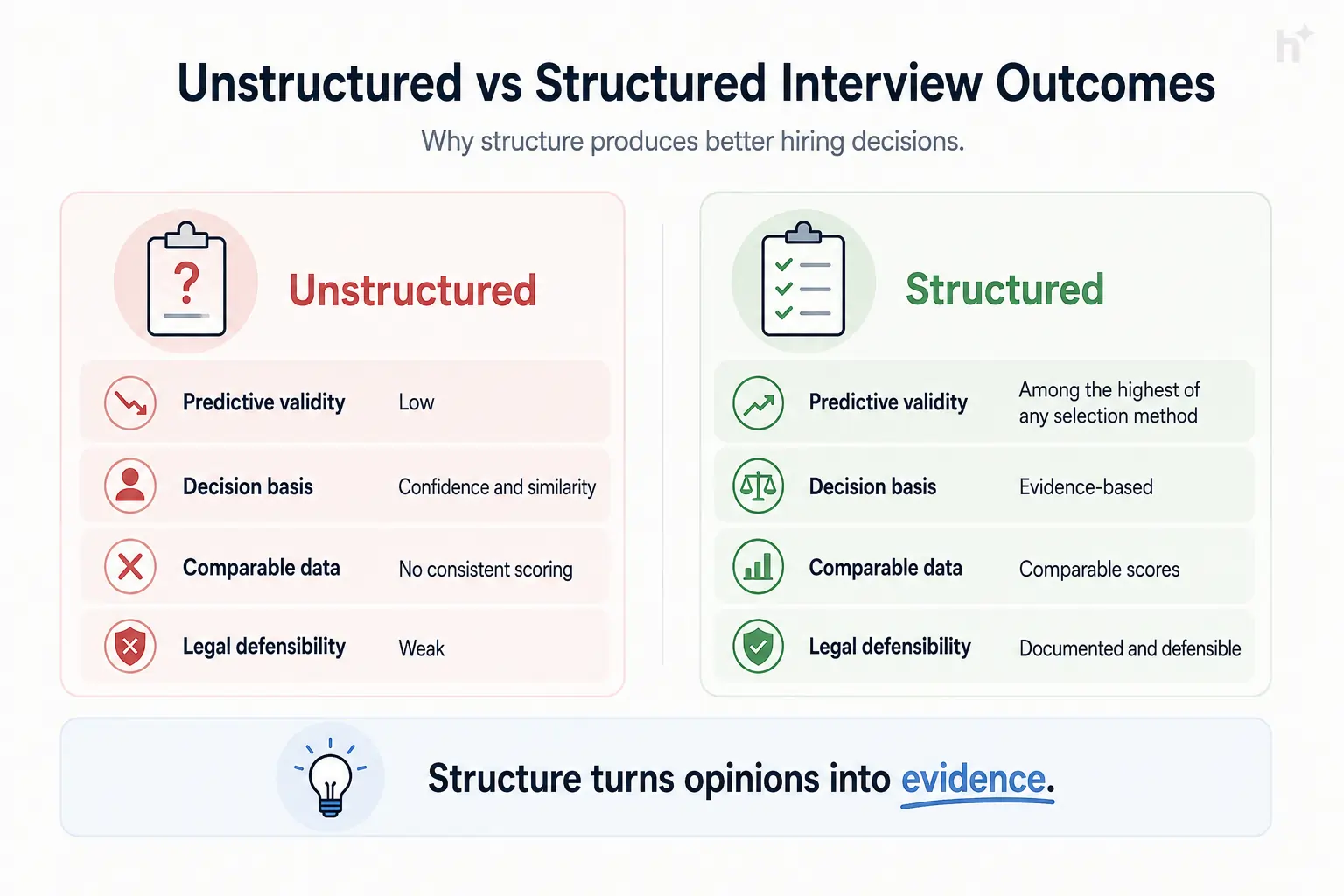
Better predictions. Same questions plus anchored scoring concentrates the interview on job-relevant evidence, which is why validity roughly doubles versus freeform conversation.
Comparable candidates. When candidate A and candidate B answered the same questions on the same scale, “who’s stronger on stakeholder management?” has an answer in the data instead of in whoever speaks first.
Faster, calmer debriefs. Independent scores turn debriefs into focused comparisons. Disagreements become specific (“you scored the conflict example a 2, I scored it a 4, let’s look at it”) and resolvable.
Interviewer development. Calibration sessions and shared anchors teach interviewers what good evidence looks like. New interviewers become useful in weeks instead of years.
Defensibility. Every decision traces to documented, job-related evidence collected identically from every candidate. That’s the posture you want in any dispute, internal or legal.
| Dimension | Unstructured | Structured |
|---|---|---|
| Predictive validity | Low; confidence and similarity dominate | Among the highest of any method |
| Candidate comparison | Apples to oranges | Same questions, same anchors |
| Debrief | Hour of anecdotes, loudest voice wins | 20 minutes of evidence comparison |
| Bias surface | Maximum room to operate | Narrowed channel, auditable |
| Documentation | Vibes in retrospect | Scores + evidence, timestamped |
💡 Pro Tip: If you adopt only one element of structure, make it independent scoring before discussion. It costs nothing, requires no new materials, and removes the single biggest distortion in hiring decisions: the anchor set by whoever talks first.
Build in sequence: define competencies from the role’s outcomes, write behavioral question banks, anchor the scorecards, assign and calibrate interviewers, then run independent scoring with evidence-first debriefs.
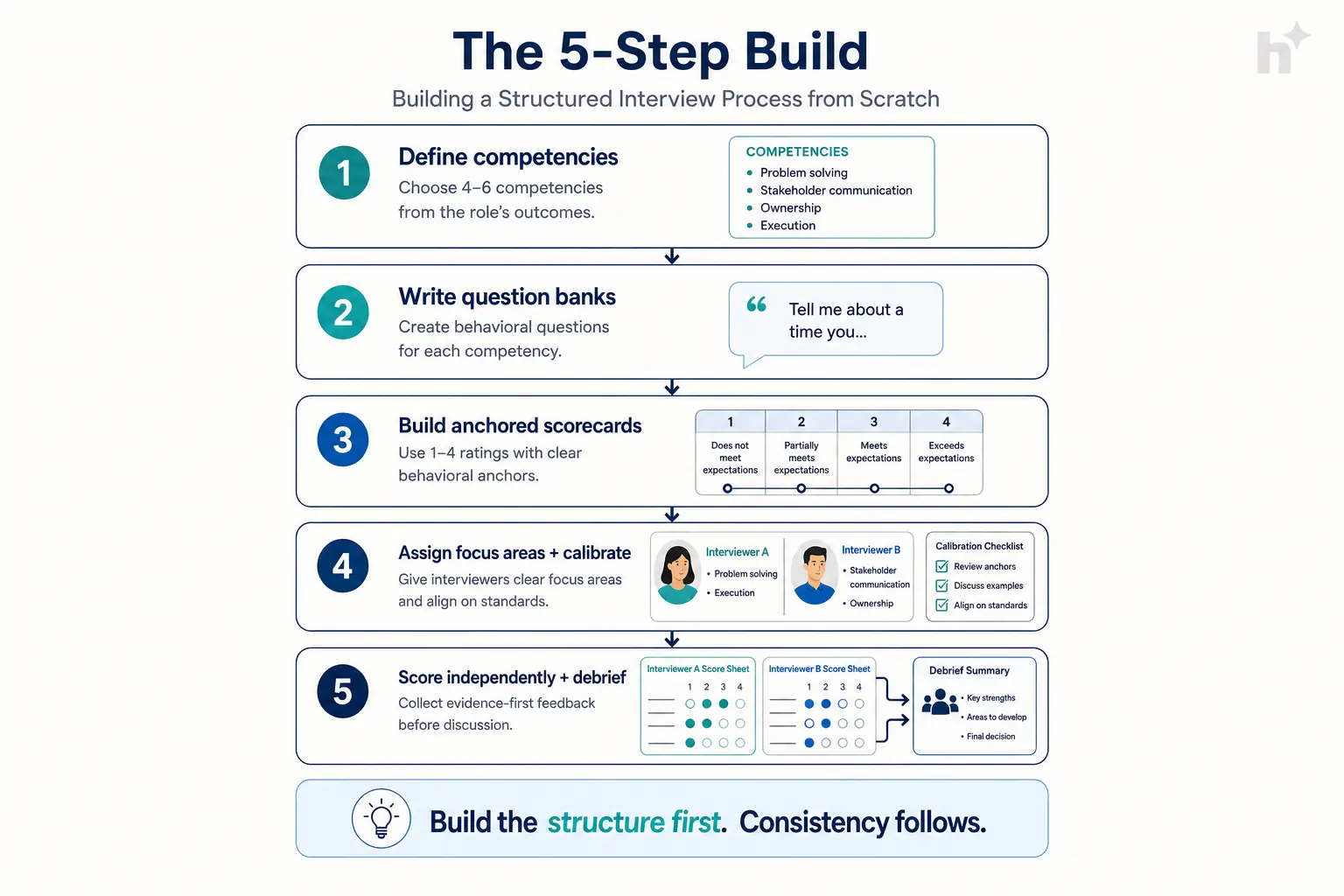
Input: The role’s first-year outcomes, agreed with the hiring manager.
Process: Work backward from outcomes to capabilities: “ship the migration in Q2” implies technical depth, cross-team communication, and ambiguity tolerance. Write each as observable behavior. Cap at 6; beyond that, interviews go shallow on everything.
Output: A written competency list that doubles as the interview plan and the eventual scorecard skeleton.
Input: The competency list.
Process: Write 3 to 4 behavioral questions per competency (“Tell me about a time…”), each with 2 to 3 planned follow-up probes (“What was your specific role?” “What did it cost?” “What would you do differently?”). Probes are where evidence quality is won; first answers are usually rehearsed.
Output: A question bank per competency, shared across all interviewers for the role.
Input: Questions and competencies.
Process: Build a 1-to-4 scale per competency with written behavioral anchors. Example for ownership: 1 = describes team outcomes with no personal role; 2 = personal role stated but vague; 3 = specific personal actions with plausible impact; 4 = specific actions with measurable outcome they personally drove, verified by probing. Four points, not five: no comfortable middle.
Output: Scorecards where the same answer earns the same score regardless of who’s rating.
Input: Your interview panel and the materials from steps 1 to 3.
Process: Assign each interviewer 1 to 2 competencies so coverage is complete without repetition (candidates hate answering the same question three times). Run a 45-minute calibration: score two recorded or role-played answers together, argue the gaps, align on anchors.
Output: A panel where focus areas are owned and a 3 means the same thing to everyone.
Input: Completed interviews.
Process: Scores and written evidence go into the system within 2 hours, before any hallway conversation. The debrief reviews competency by competency: where scores agree, move on; where they diverge, examine the evidence. The hiring manager decides with the matrix visible, and “culture fit” without a named behavior doesn’t count as evidence.
Output: A decision with a documented trail, made on what candidates demonstrated rather than who advocated loudest.
The most impactful operating rule is scores-before-discussion, enforced by the workflow rather than by trust.
Enforce independent submission. Before: scores discussed at lunch, then “recorded” in suspicious agreement. After: the ATS locks debrief scheduling until all scorecards are in. Score variance becomes visible and useful.
Probe past the rehearsed answer. Before: polished first answers earn 4s. After: interviewers trained on the three probes (role, cost, counterfactual), and scores reflect verified specifics. Rehearsed candidates and substantive ones finally separate.
Keep one wildcard slot, structured. Before: structure purists ban all spontaneity and interviewers go rogue anyway. After: each interview reserves 10 minutes for follow-the-thread questions, with the rule that scores still come only from competency evidence. Compliance rises because the conversation still breathes.
Refresh question banks quarterly. Before: questions leak to forums and answers converge. After: each bank holds 3 to 4 questions per competency, rotated quarterly, with leaked questions retired.
Audit score patterns twice a year. Before: one interviewer’s 4s are another’s 2s for years, silently. After: a simple distribution review per interviewer flags drift, feeding the next calibration session.
| Condition | Recommended Action | Expected Outcome |
|---|---|---|
| Interviewers resist “scripts” | Frame as coverage + wildcard slot, show validity data | Adoption without rebellion |
| High-volume role | 2-interviewer loops, tighter banks, same anchors | Throughput with comparability |
| Senior/executive hires | Same structure, deeper probes, more evidence per competency | Rigor where stakes peak |
| Remote interviews | Same kits + recorded (consented) answers for calibration | Consistency across locations |
⚠️ Watch Out: The process fails quietly when scorecards get filled out after the debrief. Backfilled scores always agree, and always launder the room’s bias into official-looking data. Submission timestamps are your integrity check.
The most common challenge is interviewer resistance: experienced interviewers who believe their judgment outperforms any rubric.
Veteran interviewers experience structure as an insult. Solution: show the validity research once, then make the practical case: structure doesn’t replace judgment, it aims judgment at evidence. The wildcard slot and probe freedom keep the craft in it. Converts usually arrive after their first 20-minute debrief.
Identical questions can read as impersonal if delivered robotically. Solution: train delivery, not just content: context-setting (“we ask everyone the same core questions so it’s fair”), natural follow-ups, and the wildcard slot. Candidates consistently rate fairness-framed structure positively.
Every stakeholder adds two competencies and interviews become surveys. Solution: hard cap at 6, ranked by the hiring manager. Anything below the cut becomes a screening criterion or an onboarding topic instead.
Six months in, 4s inflate and the scale compresses. Solution: semiannual calibration with the same two benchmark answers, plus the score-distribution audit. Drift is normal; unmeasured drift is the problem.
Teams that complete the 5-step build report faster debriefs, fewer mis-hires, and measurably more consistent decisions within two quarters.
Fintech scale-up, engineering hiring. Problem: hiring manager rejection of offers approved in debriefs, and 90-day regret on 1 in 6 engineering hires. Intervention: full 5-step build for the engineering role family, with locked independent scoring. Measured outcome: 90-day regret fell to 1 in 19 hires over three quarters, and average debrief time dropped from 55 to 22 minutes.
Retail group, store manager pipeline. Problem: 12 regional directors interviewing 12 different ways; promotion decisions challenged as favoritism. Intervention: one competency model, shared banks and anchors, calibration for all directors, score audits. Measured outcome: inter-rater agreement rose sharply on benchmark answers, internal promotion disputes fell to zero the following year, and the documented process survived an external review without findings.
Healthcare network, nursing leadership. Problem: panel interviews where the chief’s opinion decided everything by minute ten. Intervention: independent pre-debrief scoring with the chief’s scores submitted on the same timestamped basis as everyone’s. Measured outcome: panel members’ scores stopped converging on the chief’s, two hires the old process would have rejected became top performers, and the chief became the policy’s loudest advocate.
💡 Pro Tip: The healthcare case names the quiet enemy: hierarchy. Independent scoring isn’t aimed at bad interviewers. It’s aimed at the gravitational pull of the most senior person in the room, which distorts even good panels.
The most telling metric is inter-rater agreement on shared competencies, because comparability is the whole point of structure.
Inter-rater agreement. Definition: how closely interviewers’ scores align on the same candidate and competency. Calculation: average absolute score gap on shared competencies, or correlation across panels, reviewed quarterly. Target benchmark: average gaps under 1 point on the 4-point scale; larger gaps feed calibration.
Scorecard completion before debrief. Definition: process integrity measure. Calculation: scorecards submitted before debrief scheduling ÷ total, from timestamps. Target benchmark: 100%; anything less means the core rule is leaking.
90-day quality signal. Definition: early hire outcomes against interview predictions. Calculation: manager satisfaction + retention at 90 days, compared by interview score band. Target benchmark: higher score bands should visibly outperform lower ones; if they don’t, your competencies or anchors miss the job.
Debrief duration. Definition: a proxy for evidence quality. Calculation: average debrief minutes per role family. Target benchmark: 20 to 30 minutes; hour-long debriefs mean scores aren’t carrying the discussion.
Candidate fairness rating. Definition: how the process feels from the other chair. Calculation: post-interview pulse survey, all outcomes included. Target benchmark: fairness scores at or above your pre-structure baseline, typically above.
| Metric | What It Measures | How to Calculate | Target Benchmark |
|---|---|---|---|
| Inter-rater agreement | Comparability | Avg score gap on shared competencies | < 1 point gap |
| Pre-debrief completion | Process integrity | Timestamped submissions ÷ total | 100% |
| 90-day quality signal | Predictive power | Outcomes by score band | Higher bands outperform |
| Debrief duration | Evidence quality | Avg minutes per debrief | 20 to 30 min |
| Candidate fairness | Experience | Pulse survey | ≥ baseline |
The highest-severity risk is cosmetic structure: scorecards and question banks that exist on paper while decisions still happen in the hallway.
Structure theater. Materials exist, the debrief ignores them, and the documentation now falsely implies rigor. Mitigation: timestamps, locked debrief scheduling, and leadership actually deciding from the matrix.
Bad competencies, faithfully measured. A precise process aimed at the wrong capabilities produces confident wrong answers. Mitigation: derive competencies from role outcomes, and check them against 90-day results twice a year.
Over-templating the human moment. Interviews that feel like depositions cost you candidates in competitive markets. Mitigation: delivery training, the wildcard slot, and fairness framing up front.
Question leakage. Banks stabilize, answers converge, scores inflate. Mitigation: quarterly rotation and probe-heavy scoring: probes are leak-proof because they chase the candidate’s own story.
⚠️ Watch Out: If your debrief regularly overturns the scorecards, you don’t have a structured process with human judgment on top. You have an unstructured process with paperwork underneath, and the paperwork now documents your inconsistency.
Structure is becoming the substrate for AI-assisted interviewing: tools that draft competency kits, transcribe evidence against scorecards, and flag calibration drift automatically.
AI-drafted interview kits. Platforms now generate competency models, question banks, and anchored scorecards from a job description in minutes, moving the build cost from weeks toward days, with human editing where the judgment lives.
Evidence capture from transcripts. With consent, AI interview tools map transcript passages to competencies, pre-filling evidence fields and leaving scoring to humans. Note-taking stops competing with listening.
Continuous calibration analytics. Score-distribution and drift monitoring is moving from manual audits into platform dashboards, flagging the interviewer whose 4s quietly became everyone else’s 2s.
Structured-by-default tooling. As AI interviews handle early screening rounds, regulators and candidates alike are pushing the same expectations (consistency, anchors, audit trails) onto human rounds, which makes building structure now a head start rather than a catch-up.
A structured interview process asks every candidate for a role the same job-relevant questions, scored on the same anchored rating scale, by interviewers with assigned focus areas, with decisions made by comparing documented evidence. It’s a coverage-and-comparison system, not a conversation script.
Decades of meta-analytic research show structured interviews are among the most predictive selection methods available, while unstructured conversations rank near the bottom because they reward confidence, fluency, and similarity to the interviewer. Structure also narrows the room bias has to operate in and produces documentation that holds up under scrutiny.
Five steps: define 4 to 6 competencies from the role’s outcomes, write 3 to 4 behavioral questions per competency with planned probes, build anchored 1-to-4 scorecards, assign interviewers focus areas and calibrate them on benchmark answers, and require independent scoring before an evidence-first debrief. Budget 2 to 3 weeks per role family for the first build.
The competency being assessed, the questions asked, a 1-to-4 scale with written behavioral anchors for each rating, a required evidence field (what the candidate actually said or did), and a submission timestamp. Avoid 5-point scales: the comfortable middle absorbs every difficult judgment.
No, when delivered well. Candidates consistently rate processes as fairer when told everyone answers the same core questions, and structure prevents the repetitive interviews candidates complain about most. The risks are delivery problems, robotic reading and zero spontaneity, which a wildcard slot and basic interviewer training fix.
For most roles: a screening stage, then 3 to 4 structured interviews of 45 to 60 minutes covering 4 to 6 competencies, completed within 1 to 2 weeks. Debriefs run 20 to 30 minutes when independent scoring is enforced. Total candidate interview time should stay under 5 hours for all but executive roles.
A structured interview process is the rare upgrade that improves accuracy, fairness, speed, and defensibility at once, and costs nothing but discipline. Build the five pieces, enforce scores-before-discussion, calibrate twice a year, and your interviews start measuring the job instead of the performance of confidence.
The permanent tension is structure versus spontaneity, and the resolution is the design: fixed coverage, anchored judgment, and a breathing conversation inside it.
If you’re building structured interviews and want the system to enforce what policy alone can’t, see how hiremore AI handles interview kits, independent scoring, and evidence-first debriefs, with the timestamps built in. Structure that lives in the workflow tends to survive contact with busy weeks.
Ready to hire smarter?
Build structured pipelines, screen candidates with AI, and keep your team aligned from first application to final offer.
