


An AI-powered ATS that simplifies shortlisting, tagging, and workflows - built for fast, scalable, and collaborative hiring.
Landing Pages
Copyright © 2026|hiremore AI
An AI-powered ATS that simplifies shortlisting, tagging, and workflows - built for fast, scalable, and collaborative hiring.






Roughly 95% of US employers run background checks on at least some hires, and a substantial share of them are doing it with legal exposure they don’t know they’re carrying. Background checks are the verification stage of hiring: confirming identity, employment history, education, credentials, and where lawful and relevant, criminal records, before a candidate starts.
The recruiter’s problem isn’t whether to check. It’s what to check for which roles, how to sequence it legally, and how to keep verification from adding a week to every start date. Done carelessly, background checks generate three kinds of damage: class-action exposure under the Fair Credit Reporting Act (FCRA), discrimination claims under Equal Employment Opportunity Commission (EEOC) guidance, and good candidates lost to slow, opaque processes.
This guide covers background check best practices for recruiters end to end: role-scoped check design, the compliant sequence step by step, fair chance laws, turnaround management, and the metrics that tell you whether your verification stage is working.
- Scope background checks to the role, not the maximum available: identity and employment verification for standard roles, expanding to criminal, credit, or license checks only where the role’s duties justify them.
- The FCRA sequence is non-negotiable: standalone disclosure, written consent, and if results raise concerns, a pre-adverse action notice with a copy of the report and a genuine waiting period before any final decision.
- EEOC guidance requires individualized assessment of criminal records: nature of the offense, time elapsed, and relevance to the role, not blanket exclusions.
- Ban-the-box and fair chance laws in 37+ states and many cities restrict when criminal history can be asked about; most teams should simply run checks post-conditional-offer everywhere.
- Standard checks should complete in 2 to 4 business days; anything routinely slower is costing you start dates and occasionally candidates.
Background checks are post-offer verifications of a candidate’s identity, work history, education, credentials, and, where lawful and job-relevant, criminal or financial records, conducted through a consumer reporting agency under FCRA rules.
The component checks differ in purpose and regulation. Employment and education verification confirm the resume’s claims. License and sanctions checks confirm legal ability to do regulated work. Criminal record checks assess specific, job-relevant risk, and they’re the most heavily regulated component. Credit checks are lawful for only a narrow set of financial roles in many jurisdictions, and banned for most roles in several states.
Three terms recruiters need exactly right:
Consumer reporting agency (CRA): the third-party provider running checks; using one triggers FCRA obligations.Adverse action: declining to hire based wholly or partly on a background report, which triggers a mandatory two-step notice process.Individualized assessment: the EEOC-recommended review of a criminal record’s nature, age, and job relevance before any decision.One scoping principle organizes everything else: check what the role justifies, nothing more. Over-checking isn’t diligence. It’s cost, delay, and legal surface area with no offsetting benefit.
Practice matters because background checks sit at the intersection of three failure modes: FCRA class actions for paperwork errors, discrimination claims for blanket exclusions, and lost candidates from slow, opaque verification.
The FCRA risk is mundane and expensive. The most commonly litigated error is also the most clerical: burying the disclosure inside the application or adding extra language to it, when the law requires a standalone document. FCRA class actions over disclosure formatting have produced settlements in the millions, for paperwork.
The discrimination risk comes from blanket rules. “No one with a record” policies create disparate impact, and EEOC guidance has been clear for over a decade: criminal history must be assessed individually against the job. Fair chance laws in most states now also control when you can ask at all.
And the candidate risk is quieter: a verification stage that takes 10 days with no status visibility loses people who have competing offers and start-date pressure. Your check provider’s turnaround is part of your candidate experience whether you think of it that way or not.
📊 Key Stat: Industry surveys consistently put standard background check turnaround at 2 to 4 business days, while delayed checks, usually stuck on manual employment verifications, can stretch past two weeks. The gap between those numbers is pure start-date delay.
The primary benefit is risk reduction without speed loss: catching the misrepresentations that matter while keeping time-to-start intact and treating candidates fairly enough that the process never costs you one.
Misrepresentation caught before it’s expensive. Industry studies regularly find embellishment or misrepresentation in a meaningful share of resumes. Verification catches the consequential cases, fabricated credentials in regulated roles, before day one instead of during an incident.
Compliance that runs itself. A templated, sequenced process (disclosure, consent, scoped check, adverse action workflow) turns a legal minefield into a checklist that any recruiter can run identically every time.
Faster starts. Ordering checks at conditional offer, scoping them tightly, and collecting verification-ready data (exact employer names, dates, license numbers) at application cuts days off median turnaround.
Fairness you can demonstrate. Individualized assessments and consistent scope-by-role rules mean every decision has a documented, job-related rationale, which protects candidates and the company simultaneously.
| Aspect | Ad Hoc Checks | Well-Run Verification Stage |
|---|---|---|
| Scope | Maximum package for everyone | Tiered by role justification |
| Sequence | Varies by recruiter | Templated FCRA workflow |
| Turnaround | 5 to 14 days, unpredictable | 2 to 4 days median, tracked |
| Criminal records | Blanket rules or gut calls | Individualized assessment, documented |
| Candidate view | Silence | Status visibility + named contact |
💡 Pro Tip: Collect verification-ready data upfront: exact legal employer names, precise employment dates, and license numbers in the application or offer packet. Half of all check delays are the provider chasing fuzzy data your candidate could have given you in 2 minutes.
The compliant sequence runs: conditional offer, standalone disclosure and written consent, role-scoped check, results review, and, if concerns arise, the two-step adverse action process with an individualized assessment in between.
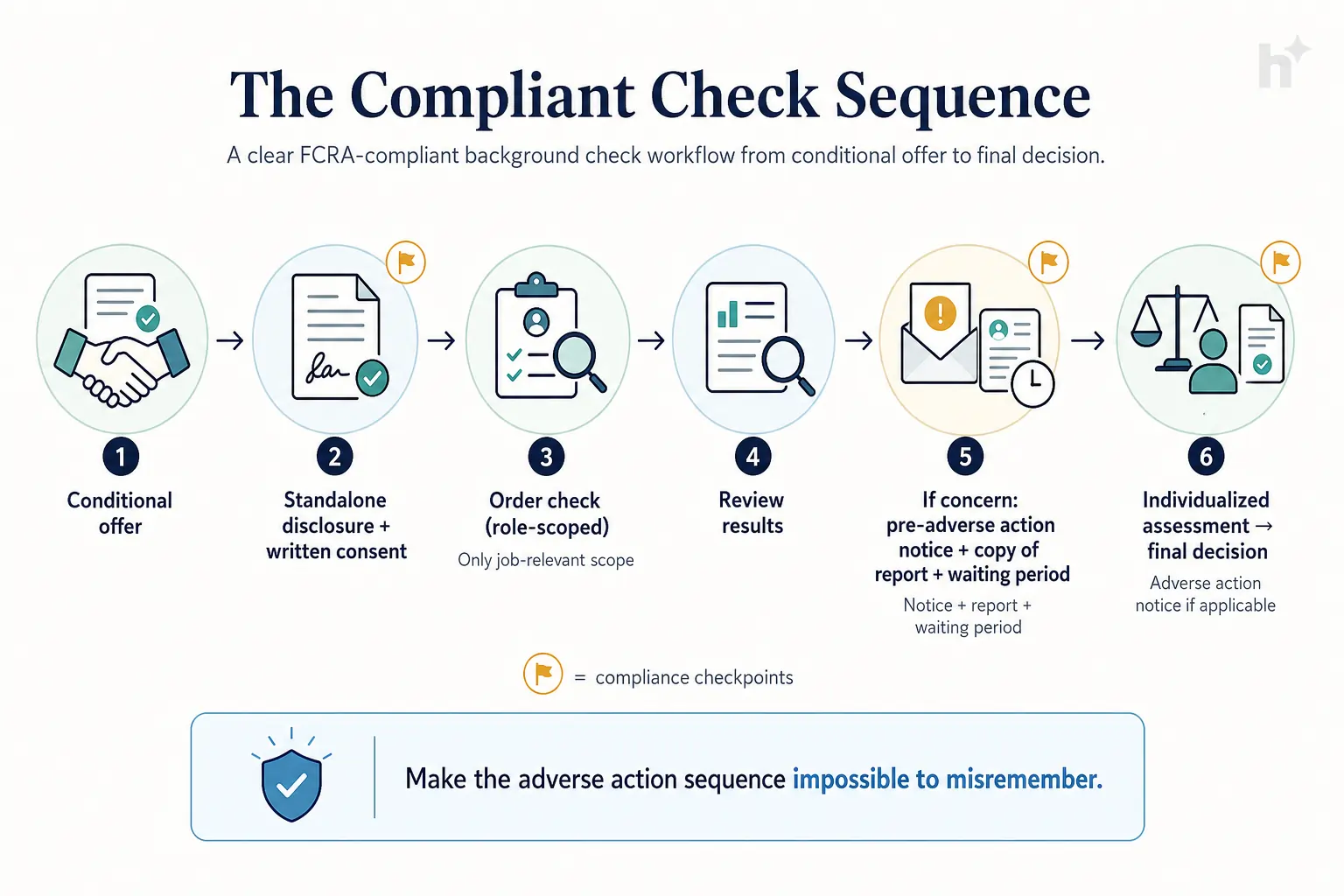
Input: Your final candidate and a written offer contingent on verification.
Process: Run checks post-offer. It satisfies ban-the-box timing in essentially every jurisdiction, signals good faith to candidates, and means you only pay for checks on people you intend to hire.
Output: A signed conditional offer and a candidate expecting the verification step.
Input: FCRA-compliant forms from your provider or counsel.
Process: The disclosure must be a standalone document, no extra waivers, no liability releases, no burying it in the application. Collect written (or compliant electronic) consent. This is the step that generates the class actions; template it once, correctly, and never improvise.
Output: Documented consent attached to the candidate record.
Input: The role’s check tier (standard / trust-sensitive / regulated) and the candidate’s verification-ready data.
Process: Order only the components the role justifies. Track turnaround daily; checks stuck past day 4 are almost always waiting on a manual employment verification you can unstick with the candidate’s help (pay stubs, W-2s as alternatives).
Output: A completed report, typically in 2 to 4 business days.
Input: The completed report.
Process: Clear reports proceed to start-date confirmation same day. For concerns: send the pre-adverse action notice with a copy of the report and the CFPB Summary of Rights, wait a genuine period (5 business days is common practice) for the candidate to respond or dispute, run the EEOC individualized assessment (nature, age, relevance), then decide. If declining, send the final adverse action notice.
Output: Either a confirmed hire or a documented, defensible decision with every step timestamped.
| Step | Owner | Timing | Compliance Checkpoint |
|---|---|---|---|
| Conditional offer | Recruiter | Day 0 | Fair chance timing satisfied |
| Disclosure + consent | Recruiter (templated) | Day 0 | Standalone document, no extras |
| Scoped check | Provider | Days 1 to 4 | Role-justified components only |
| Review / adverse action | Recruiter + HR | Days 4 to 10 | Pre-notice, waiting period, assessment |
The single most impactful practice is tiering check scope by role and writing the tiers down, because consistent scope is what makes every downstream decision fast and defensible.
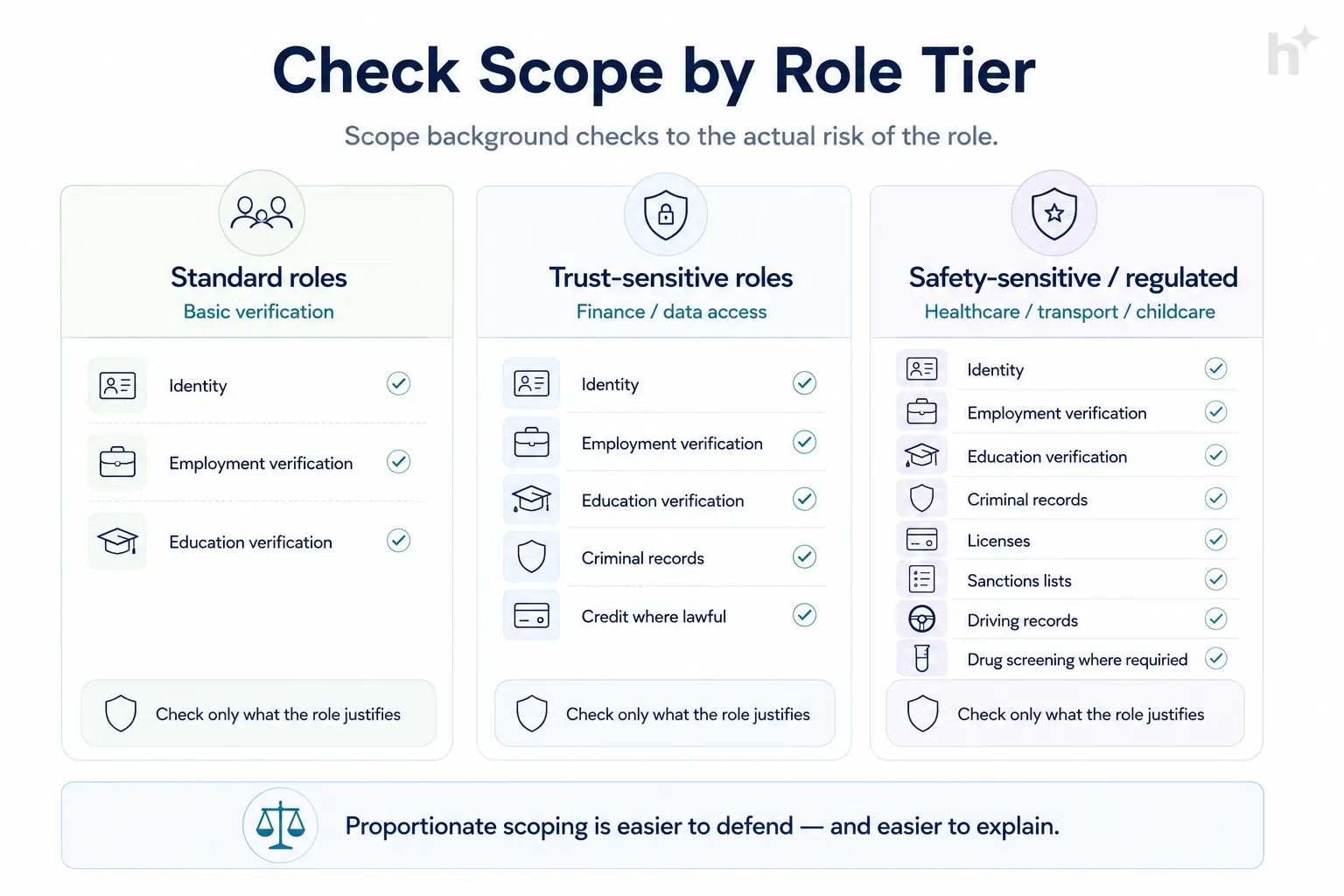
Tier your check packages. Before: every hire gets the maximum package, costing 2x and inviting scope questions. After: three written tiers (standard, trust-sensitive, regulated) applied automatically by role family. Costs drop, turnaround improves, and “why was I credit-checked for a marketing job?” never gets asked.
Template the FCRA paperwork once. Before: each recruiter adapts forms, and one helpful added sentence voids the disclosure. After: locked templates reviewed by counsel annually, used identically by everyone.
Order at conditional offer, not at final interview. Before: checks run on 3 finalists, paying triple and raising timing issues in fair chance jurisdictions. After: one check per hire, post-offer, compliant everywhere.
Keep candidates informed. Before: a 6-day silent gap between offer and start-date confirmation breeds anxiety and ghosting. After: an expectations email at consent (“typically 3 to 5 business days, here’s your contact”) and a status ping at day 3. Renege rates drop measurably.
Run the individualized assessment every time. Before: a flagged record triggers an automatic no, creating disparate impact. After: a documented 3-factor review (nature, time elapsed, job relevance) with the candidate invited to add context. Fairer, and it’s what the EEOC expects to see.
Audit your provider quarterly. Before: turnaround creep goes unnoticed until a hiring manager escalates. After: a quarterly review of median turnaround, dispute rates, and stuck-check causes, with the data driving provider conversations.
| Condition | Recommended Action | Expected Outcome |
|---|---|---|
| High-volume hourly hiring | Standard tier + instant identity/database checks | Sub-48-hour clears for most candidates |
| Regulated roles (healthcare, finance, transport) | Regulated tier + license/sanctions automation | Zero day-one credential surprises |
| Multi-state hiring | Post-offer checks everywhere + state law matrix from counsel | One compliant process, not fifty |
| Candidate disputes a finding | Pause clock, honor dispute process, document | FCRA-clean outcome either way |
⚠️ Watch Out: The waiting period after a pre-adverse action notice must be real. Sending the pre-notice and the final rejection in the same week, or worse, the same day, is the second most common FCRA violation after disclosure formatting, and it’s visible in your own timestamps.
The most common operational challenge is turnaround: checks that stall on manual verifications and quietly push start dates.
A former employer won’t answer verification calls, and day 4 becomes day 11. Solution: monitor daily, and at day 4 invoke alternatives: candidate-supplied W-2s or pay stubs satisfy most employment verifications. Your provider should support document-based verification by default.
Candidates with overseas employment or education stretch timelines and provider capabilities. Solution: set expectations early (7 to 14 days for international components), order those components first, and use providers with genuine in-country verification networks rather than best-effort emails.
Two candidates, similar records, opposite outcomes, decided by different managers. Solution: route all flagged reports through one trained reviewer (or small panel) using the documented 3-factor assessment, with HR sign-off on any decline.
Ban-the-box timing, credit check bans, and salary history rules differ by state and city. Solution: adopt the strictest common denominator as your default process (post-offer checks, no credit components unless role-mandated), and keep a counsel-maintained exceptions matrix for the rest.
Teams that tier scope, template compliance, and monitor turnaround cut both legal exposure and start-date delay, with measurable gains in one quarter.
National retailer, 8,000 seasonal hires. Problem: maximum-package checks on every hourly hire: 6-day average turnaround, $41 per check, and seasonal start dates slipping. Intervention: a standard tier (identity, database, sex offender registry) for hourly roles with instant-verify components. Measured outcome: median clear time dropped to 31 hours, per-check cost fell 44%, and seasonal fill timelines held for the first time in three years.
Regional bank, trust-sensitive roles. Problem: a near-miss FCRA dispute revealed recruiters using three different consent forms, one with added waiver language. Intervention: locked counsel-reviewed templates, a single adverse action workflow in the ATS, and quarterly audits. Measured outcome: 100% template compliance at the next audit, and the adverse action process produced complete documentation in all 9 cases that arose the following year.
Home healthcare provider, regulated hiring. Problem: license and sanctions checks ran post-offer manually, and 1 in 15 finalists failed late, restarting searches. Intervention: license verification moved into application-stage knockouts via API, with full checks remaining post-offer. Measured outcome: late-stage failures fell to under 1 in 100, recovering roughly 3 weeks per affected requisition.
💡 Pro Tip: The healthcare case repeats a pattern from screening generally: move the deterministic checks (license validity) as early as the law allows, and keep the judgment-laden checks (records review) post-offer where they belong.
The most important metric is median turnaround time, because verification speed is the difference between checks as a safeguard and checks as a bottleneck.
Median turnaround. Definition: business days from check order to completed report. Calculation: median per month, segmented by tier and domestic/international. Target benchmark: 2 to 4 days standard tier; investigate any month trending above 4.
Stuck-check rate. Definition: share of checks open past day 4; your bottleneck finder. Calculation: checks open > 4 days ÷ total checks. Target benchmark: under 15%, with documented causes (usually manual employment verification).
Discrepancy rate. Definition: share of checks surfacing material differences from candidate claims; justifies the program. Calculation: reports with material discrepancies ÷ total reports. Target benchmark: track your own baseline; investigate sharp changes in either direction.
Adverse action compliance. Definition: share of declines with complete documented sequence (pre-notice, waiting period, assessment, final notice). Calculation: quarterly audit of all adverse action files. Target benchmark: 100%. This is the metric where anything less is a finding.
Offer-to-start time. Definition: days from conditional offer to confirmed start; the candidate-felt outcome. Calculation: median days, monthly. Target benchmark: verification should add no more than 3 to 5 days to offer-to-start for standard roles.
| Metric | What It Measures | How to Calculate | Target Benchmark |
|---|---|---|---|
| Median turnaround | Provider + process speed | Median days, by tier | 2 to 4 days standard |
| Stuck-check rate | Bottlenecks | Open > 4 days ÷ total | < 15% |
| Discrepancy rate | Program value | Material discrepancies ÷ reports | Baseline + trend watch |
| Adverse action compliance | Legal hygiene | Quarterly file audit | 100% |
| Offer-to-start | Candidate impact | Median days monthly | Checks add ≤ 3 to 5 days |
The highest-severity risk is the procedural FCRA violation, because it’s strict-liability-flavored, class-action-friendly, and almost always self-inflicted through paperwork shortcuts.
Disclosure formatting violations. Extra language in the standalone disclosure is the most-litigated error in employment screening. Mitigation: locked templates, annual counsel review, zero improvisation.
Compressed adverse action. Pre-notice and final notice sent too close together demonstrates the waiting period was theater. Mitigation: workflow-enforced delays in the ATS, with timestamps you’d be comfortable showing a judge.
Blanket criminal exclusions. Automatic disqualification rules create disparate impact regardless of intent. Mitigation: individualized assessment, every time, documented.
Over-scoped checks. Credit checks on roles with no financial duties are banned in several states and indefensible everywhere. Mitigation: the written tier system, enforced by your provider configuration so the wrong package can’t be ordered.
Stale data decisions. Acting on expunged, sealed, or outdated records that providers shouldn’t have reported. Mitigation: use PBSA-accredited providers and honor disputes by pausing the clock, not the candidate.
⚠️ Watch Out: “Our provider handles compliance” is a half-truth that has cost employers millions. Providers handle their obligations as CRAs. The disclosure, consent, adverse action sequence, and final decision are yours, and so is the liability when they’re botched.
Verification is getting faster and more continuous: instant database checks, candidate-owned verified credentials, and post-hire monitoring in regulated industries.
Instant and API-based verification. Payroll-data networks and credential APIs are turning employment and license verification from phone-call archaeology into sub-hour confirmations, compressing standard-tier turnaround toward same-day.
Candidate-owned credentials. Verified digital credentials (degrees, licenses, work history attestations) that candidates carry between employers are moving from pilot to production, flipping verification from employer-pulls to candidate-presents.
Continuous monitoring in regulated sectors. Healthcare and transport are shifting from point-in-time checks to ongoing license and sanctions monitoring, which changes the recruiter’s role from gatekeeper to subscription manager, and raises consent and privacy questions worth settling with counsel now.
Fair chance momentum. Ban-the-box and clean-slate legislation keeps expanding, including automated record sealing in several states. Post-offer checking with individualized assessment is aging well as the default posture.
Five fundamentals: run checks after a conditional offer, scope components to what the role justifies, use locked FCRA-compliant disclosure and consent templates, follow the full two-step adverse action sequence with an individualized assessment for any record, and track median turnaround so verification never silently becomes the bottleneck.
Depending on the package ordered: identity verification, employment history, education and credential verification, criminal records within reportable limits, and for specific roles, driving records, license and sanctions checks, or credit history where lawful. Checks only contain what the employer orders, which is why role-scoped tiers matter.
Standard packages complete in 2 to 4 business days. International components run 7 to 14 days. The most common delay is manual employment verification, which candidates can usually unstick by providing W-2s or pay stubs as alternative documentation.
Yes, with process. FCRA requires a pre-adverse action notice with a copy of the report, a genuine waiting period for the candidate to respond or dispute, and a final adverse action notice if you proceed. For criminal records, EEOC guidance expects an individualized assessment of the offense’s nature, age, and relevance to the role rather than blanket exclusions.
After a conditional offer, in essentially all cases. Post-offer timing satisfies ban-the-box and fair chance laws across jurisdictions, limits spend to candidates you actually intend to hire, and keeps criminal history out of interview-stage decisions where it doesn’t belong.
Yes, arguably more than large ones: FCRA liability doesn’t scale down, and a single class action or negligent hiring claim hits a small company harder. The fixed cost is low: tiered packages, two locked templates, and a written adverse action sequence cover most of the risk.
Background checks reward boring discipline: scope tiers written down, FCRA templates locked, the adverse action clock honored, and turnaround watched like the operational metric it is. None of it is hard. All of it has to happen every single time, which is exactly what a templated workflow is for.
The tension to hold: thoroughness and speed pull against each other, and the resolution is scope. Check what the role justifies, verify it fast, and reserve the deep dives for the roles that genuinely demand them.
If your verification stage runs on sticky notes and provider portals, see how hiremore AI builds background checks into the hiring workflow: ordered at offer, tracked daily, with the adverse action sequence enforced by the system instead of memory.
Ready to hire smarter?
Build structured pipelines, screen candidates with AI, and keep your team aligned from first application to final offer.
